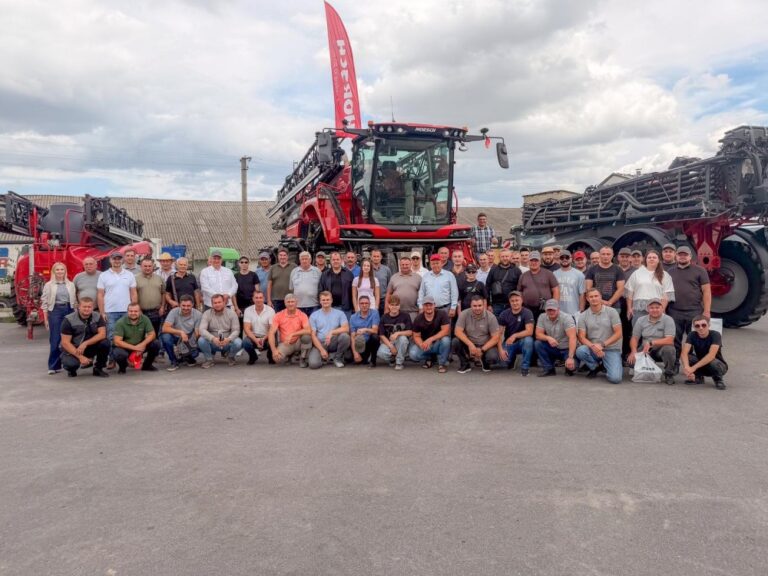
«Astra» Agro-Building Alliance — one of the largest suppliers and service operators of agricultural machinery in Ukraine — recently joined the “Ukrainian Agribusiness Club” association. In a personal interview, technical director Andrii Manziuk talked about the specifics of running a distribution company during wartime, how the transformation of logistics routes has affected the machinery market, and ways to ease farmers’ shortage of working capital.
Tell us, please, about the history of «Astra» Agro-Building Alliance’s founding and its operations
The company was founded in 1998 – at a time when large, powerful distribution companies were emerging in Ukraine. When “Astra” was founded, its main goal was selling agricultural machinery spare parts and providing service to farmers who use such machinery. Those were a kind of formative, foundational years for the market.
Already in 2005, the first dealer agreements were signed, and “Astra” became the official distributor of the Fendt, Manitou, Berthoud, and Bogballe brands. In 2007, the German brand Horsch joined our partner portfolio, in 2011 we signed an official agreement with irrigation equipment manufacturer Valley, and in 2018 we began representing the Valtra brand in Ukraine, as part of our cooperation with AGCO Corporation. And in 2020, we became the official dealer for Trimble’s GPS equipment and precision farming systems. These are the key brands we work successfully with today.
“Astra” Agro-Building Alliance has now celebrated its 25th anniversary, a landmark date for the company, since there aren’t that many examples of successful distributors in Ukraine with such a history. One of our secrets — is consistently maintaining a high level of service and good relationships with suppliers. And, of course, our team keeps developing and applying innovative solutions. But what’s decisive is precisely a stable, solid partnership with the same manufacturers over time, which means moving away from looking for shortcuts, and instead carefully building long-term business relationships. As a result — we’ve repeatedly received top-dealer awards from Fendt, Horsch, Berthoud, Manitou, and Valley.
The company’s regional representatives work across all of Ukraine, but the largest concentration of offices is in Chernihiv, Kyiv, Cherkasy, Vinnytsia, Zhytomyr, Kirovohrad, Poltava, and Khmelnytskyi.
Which categories of agricultural machinery in the company’s range are in the highest demand in 2023?
It’s hard to single out a particular category – it’s more accurate to say the machinery in highest demand is whatever is most essential for a given farm, most reliable, and most productive. Because today farmers face very difficult conditions and have to resolve a number of pressing tasks before moving on to investing in agricultural machinery. We’re currently seeing some market transformation: talking about tractors, with the Fendt brand we see farmers starting to focus their attention on 1000-series tractors, which are more powerful and efficient. There are several reasons: first, this technology allows more productive land cultivation, of higher quality and faster; second, there’s climate change, which is making tillage conditions more difficult.
So overall, I’d note that among consumer demand we see a focus on: powerful tractors, wider-reach seeding and tillage equipment, self-propelled sprayers, and versatile loader helpers.
What new agricultural machinery are you planning to offer clients in 2024?
Very soon the international Agritechnica 2023 show will take place, where our partners will present their latest developments, innovative solutions, and future trends, to set the direction for the market. One of the new items is a new generation of the S-series tractor from Valtra. We’ll talk about the others after the show.
As for new solutions “Astra” offers, our team continues to successfully develop such a tool as grain trading: our company structure has a fully functioning grain trading department, which helps our farmers in this difficult time, when grain prices are low, logistics are difficult, and all the storage bins are full of grain. Our solution — is the ability to buy machinery in exchange for grain, taking grain or sugar as an advance payment, that is, whatever the farmer has in storage. In effect, we help make sure the machinery-goods and the grain-goods achieve a mutually beneficial exchange. This is genuinely a successful tool for farmers, because it lets them get two services at once: selling their harvest and investing in agricultural machinery, from a single partner. This is how «Astra» Agro-Building Alliance helps solve the problem of limited financing and low harvest prices.
What are the specifics of the service that «Astra» Agro-Building Alliance provides?
The main trend today is that companies overall are becoming service companies. This refers to companies that understand that for a farmer today, what matters isn’t just buying machinery, but getting, as part of the same package, services that include professional, fast service, availability of spare parts, and any immediate response the client needs.
The quality and speed of the work — is one of the factors a farmer pays attention to when choosing their partner.
Over 25 years, «Astra» Agro-Building Alliance has built up an entire lineage of its own service specialists, who pass knowledge down from generation to generation. It’s also important that, first, we have 55 crews across all of Ukraine, and second, these crews are professional, regularly certified at manufacturers’ plants, at brand representative offices, or attending professional development courses.
But the most important thing, of course, is training new specialists in line with young-employee development programmes, because there still aren’t enough professional specialists given the gradually increasing sales momentum. So we’re constantly growing our service team, first bringing new employees into regional divisions, where they go through a year of on-the-job training.
Besides this, the structure of the service department plays a significant role: the whole business is divided into clusters, which cover certain regions, and in each of them we have a separate after-sales manager (ASM) position – this is the person who effectively manages all client processes related to after-sales service. That is, the salesperson’s task is to agree with the client on the machinery sale and on cooperation, and then the ASM coordinates the work of the machinery and spare-parts department to ensure a timely, fast response to all client requests. So the moment a request comes in from a client, the ASM handles all the coordination needed to quickly provide the service and supply the spare parts. This speeds up the process and improves the quality of service.
“Astra” also runs regular training for our clients’ machine operators, so the machinery is set up correctly every time before heading into the field. This practice reduces the number of warranty cases and extends the machinery’s service life.
Based on your observations, how has the full-scale war affected the machinery market and demand?
After the record year of 2021, the following years show a sharp negative trend in demand for agricultural machinery, since farmers are now operating below their profitability threshold. We have not only low grain prices, but also additional logistics costs, which fall on farmers’ shoulders.
So a farmer’s main task right now is to minimize production costs as much as possible, by optimizing spending and prioritizing their core protected expense categories – seed, fertilizer, herbicides, fuel, employee salaries, machinery repairs, spare parts, payments to shareholders – and only then does a farmer consider any investment in updating their machinery fleet.
The market for new agricultural machinery has fallen substantially over two years, while spare parts sales are growing at the same time. However, once a farmer realizes it’s no longer worthwhile to invest in repairing their machinery, they’ll buy a new machine. Also, some types of machinery, tractors for example, haven’t fallen in sales as much as other machinery segments – fertilizer spreaders, sprayers, combine harvesters. The market has slowed, but we see that farmers are still trying to find some solutions to keep operating.
One global trend — the rising world price of sugar, so «Astra» Agro-Building Alliance expects that sugar-beet planted area will probably grow too, which in turn will affect the machinery market. The market is constantly transforming, adapting to current challenges, and our company isn’t standing aside from this either.
How has the transformation of logistics chains affected the company’s operations?
Agricultural machinery continues to be imported, even though complex processes are currently happening at the borders, related to the fact that a great many goods that used to be exported by other routes are now exported through the western borders.
Imports arrive in waves, so delivery times for machinery and spare parts have grown a bit due to queues at the borders, which add 7-8 days to overall logistics. So there’s some impact, but in any case, our team plans everything well in advance, «Astra» Agro-Building Alliance always keeps the most important machinery and spare parts in stock, systematically arranges further supplies, so our client essentially doesn’t feel any particular impact.
But of course, logistics have changed compared to the pre-war period, and some logistics routes simply no longer exist. The intensified traffic at the western border, above all, affects delivery times. That’s exactly why the client also needs to plan in advance, to avoid situations where delivery timing affects agricultural production.
Does «Astra» Agro-Building Alliance help the Armed Forces and the population in areas where fighting is taking place?
Like every citizen, «Astra» Agro-Building Alliance is actively involved in supporting Ukrainians and the Armed Forces. We have a separate project, Support Ukrainian People, whose goal is to help the Ukrainian people overcome hardships: helping the army, displaced people, the state with infrastructure projects, educational institutions with installing power-generating equipment, humanitarian aid, and so on.
Many projects have been carried out in various regions of Ukraine, including supplying food, power-generating equipment, pickup trucks, and other equipment for the Armed Forces. All of this is possible thanks to our partners and our employees, who provide support both financially and with resources.
What are your expectations from membership and cooperation with the “Ukrainian Agribusiness Club” association?
Since UCAB was created to bring agricultural sector players together under one roof, to strengthen the building of solid business contacts and communication with government bodies to defend the interests of community members, «Astra» Agro-Building Alliance plans to be an active member in all these efforts. We’re ready to work intensively together with other members with ministries on certain issues, for example, creating conditions and tools to optimize logistics routes. We need to develop the agricultural sector together, because today this sector of the economy is one of the budget-forming ones for the country. And UCAB’s role — is to advise, guide, and determine where which kind of support is needed.
First and foremost, this means preserving and expanding financial instruments for market players. This is one of the key areas we need to work on together, because there’s a serious shortage of financial resources in the industry. The state needs to work more actively with various foreign financial institutions so that agricultural-sector participants get, at minimum, additional preferential financing terms, and at best, grants.
Second, staffing is an acute issue: today both farmers and distributors feel a colossal shortage of highly qualified workers, since some were lost to migration, and some employees are being mobilized. In my opinion, everyone is aware of this, but we need to keep constantly communicating with the state to resolve these issues.
So, in short, our main expectations from UCAB are the chance for the community to hear all the problems its members face and jointly bring them to government leaders and institutions, so the industry has effective tools to operate successfully.
A large community — is a powerful position in negotiations and in resolving the industry’s important challenges.
ABA “Astra” Agro-Building Alliance is one of the largest suppliers and service operators of agricultural machinery in Ukraine. The company’s core activities are the sale of new and used agricultural machinery, warranty service, and the sale of spare parts.
“Astra” offers its clients a wide range of machinery for practically every type of agricultural work: Fendt, Valtra, Manitou, Berthoud and Horsch, Framest, Bogballe, Valley, Trimble, Oros. The company supplies customers with the widest range of genuine spare parts to support all models of agricultural machinery from world-renowned manufacturers. Servicing agricultural machinery holds a key place in the company’s operations, covering nearly the entire territory of Ukraine and ensuring a fast response to farmers’ requests.
“Astra” has been operating on Ukraine’s agricultural market for 25 years, providing agricultural producers with quality machinery, innovative agricultural technologies, and a consistently high level of service