“KWS-Ukraine” fields
Together with partners, “Agro-Building Alliance “ASTRA”” and Valmont Inc. (maker of irrigation systems under the Valley brand), as part of the Hydro Tour across Ukraine, we continued studying the nuances of using irrigation systems in various regions of our country.
This time we’re in Khmelnytskyi region, in the “city of stone,” as locals call it. Yes, that’s Kamianets-Podilskyi. This is where the “KWS-UKRAINE” plant is located. It might seem like an odd connection to irrigation? But the thing is, practically 100% of the company’s hybridization fields are irrigated and located within a 200 km radius of the plant.
Before hitting the road, we turn to specialists at the “Meteo Farm” agri-weather service to ask them about weather nuances in the region. The wettest months were May and June, with 98.9 mm and 96.4 mm of rainfall respectively. The lowest rainfall was recorded in January, April and August.
Rainfall in Khmelnytskyi region in 2020, mm

As for temperature figures, the maximum temperature in Khmelnytskyi region was +35.2°C in August.

A “busy season” at the plant
We arrived at the “KWS-UKRAINE” plant in Kamianets-Podilskyi during its “busy season” — harvesting and finishing corn. As a rule, this process runs from early September through mid-October (that is, until the first frost), so the seed doesn’t lose germination. The plant’s first line was commissioned in November 2016. Today, production capacity stands at 12,000 tonnes of ear corn seed, or 350,000 seeding units. The plant also finishes seed for grain crops and rapeseed.
We’re met by the head of “KWS-UKRAINE”‘s corn and sunflower seed production department, Oleksandr Prus. He oversees every process, from field production through to seed certification. He explains that the corn hybrid fields are located in Khmelnytskyi, Ternopil, Vinnytsia and Chernivtsi regions. What’s more, the company has a rule: hybridization plots must be located on farms no more than 200 km from the plant. The most distant farm is in Vinnytsia region, 180 km away.

Oleksandr Prus, head of “KWS-UKRAINE”‘s corn and sunflower seed production department
Drought has reached Podillia too
We ask Oleksandr whether this region, traditionally rich in moisture, also needs irrigation.

“Yes, we’re in a zone that’s historically had enough moisture. Here, 5-10 years ago, nobody had heard of irrigation, and it was hard to talk with partners about launching a project like this. But over a few years, farmers came to understand that development isn’t possible without it. In this zone, by my estimate, an average year is short about 150 mm of moisture, and a difficult year even more. But in principle, we can water less too, we watch the balance.”
Oleksandr Prus
head of “KWS-UKRAINE”‘s corn and sunflower seed production department
The company began a project to roll out Valley sprinkler machines with ABA “ASTRA” five years ago. At that point, it didn’t have a single hectare “under water.” Today, 100% of its land is irrigated. Year after year, the company keeps growing its land bank under hybridization plots and, accordingly, under irrigation. According to Oleksandr Prus, in seed production, irrigation is critically important — without water, you can’t get a stable result and seed quality.

“KWS-UKRAINE” fields
“If there’s not enough moisture after sowing, you can get uneven, patchy emergence, detasseling becomes difficult, there can be issues with corn flowering synchronization and grain fill. And that affects the outcome. We can’t take that kind of seed to the plant.”
Oleksandr Prus
head of “KWS-UKRAINE”‘s corn and sunflower seed production department
And he adds that irrigation can deliver a 20-40% yield increase.
Switching to irrigation: the economics
But before switching to irrigation, Oleksandr Prus recommends farmers run the numbers: land area, crop rotation, today’s produce prices, to forecast how prices might change in the future.
He calls choosing the right equipment-supplier partner important, and cites cooperation with ABA “ASTRA” as an example. He notes the company provides not just equipment but full support. Specialists visit the site, analyze the fields, terrain, and water access. Based on that, they select the machine type, length and quantity. After that, they prepare a project specifically for seed sowing, which involves a number of nuances, such as isolating fields at a distance of 300 m, building the entire infrastructure, and so on.

An irrigation system in the field
Our interlocutor confirms that irrigation is a fairly expensive investment. The amount depends on many factors, but the key one is whether the necessary infrastructure is already in place. Will you need to build an entire water supply system from scratch, with water intake and pumps, or just bring sprinkler machines to the field? The first option is the most expensive and time-consuming, since it involves not only buying the necessary equipment but also obtaining permits.
Asked whether a farm with infrastructure problems should even “get involved” in this process, Oleksandr Prus replied that first, the farm’s manager needs to work out how many years they plan to work this land, and whether they’re ready to invest in growing the business.
“Of course, if it’s a matter of tens of kilometres to supply water, that won’t make any sense. There are farms that are ready to invest and work in this direction, but don’t have water resources (or they’re very far away).”
Oleksandr Prus
head of “KWS-UKRAINE”‘s corn and sunflower seed production department
Corn irrigation technology
There’s no issue with water supply at the farms growing corn for “KWS-UKRAINE,” since the Dniester flows nearby. The irrigation technology here is well established.
- If spring is dry, the fields are always watered once before sowing work.
- The second watering — at a lower rate — is done, if needed, after sowing, to guarantee emergence. But at this point it’s important not to over-water, since waterlogging the root system can eventually cause the corn to lodge.
- Next, the plants are watered as the third leaf forms.
- Watering before detasseling is the most critical moment, when you need to build up the greatest amount of moisture in the soil.
At first glance, it seems simple: turn on the sprinklers four times over the summer, water the fields according to already-calculated rates, and calmly wait for the harvest campaign. In reality, it’s far more complex. As Oleksandr Prus explains, there’s such a thing as “air drought,” which negatively affects plant growth and development and leads to lower yields. It’s important not to miss that moment and give the plants moisture in time. It’s also necessary to properly apply agronomic technique, use a balanced fertilization system, and even take into account the temperature of the water coming from the wells.
“Think about what would happen to corn if you watered it, at an air temperature of +35°C, with water coming from 30-metre-deep wells, at a temperature of 10°C. The plants would be stressed and growth would slow. The optimal water temperature for irrigation should be in the range of 18-20°C.”
Oleksandr Prus
head of “KWS-UKRAINE”‘s corn and sunflower seed production department
Irrigation management
Every technological operation in the fields is overseen by “KWS-UKRAINE” specialists working in tandem with the farm’s agronomists. The company has also started using the Valley Scheduling programme, which lets you remotely manage all irrigation equipment and monitor how well-supplied with moisture the plants are, and when they need watering.
“If you immediately give an elevated water rate, it’ll just run off to the edge of the field and clog the soil. Deep ruts from the sprinkler machine’s wheels will appear in the field. During an operation like detasseling, a castration machine with small wheel radii could get damaged, for example, tip over. That’s why it’s so important to regularly monitor soil moisture.”
Oleksandr Prus
head of “KWS-UKRAINE”‘s corn and sunflower seed production department

The Valley irrigation system
As Valley Scheduling’s representative in Ukraine, Viktor Skrypnyk, explained, the programme is essentially a navigator for anyone using irrigation. It accounts for what crop is sown on a given field, how much water it needs, soil type, weather conditions (including wind readings, since wind above 5 m/s causes more evaporation than high temperature), and the field area the machine covers. The user sees all this information in real time, so based on this data they can plan proper irrigation, saving money in the process.
Asked how hard the programme is to master, Viktor Skrypnyk said an agronomist with basic knowledge can confidently use it.

“We came to “KWS-UKRAINE” and trained the specialists working in the fields, so they could easily read the programme and understand when the system warns them of a moisture deficit or excess. We also ran a soil analysis at the start of the season and entered all the information into the programme. Then, throughout the season (depending on the customer’s needs), we periodically visit the fields, so we can make adjustments to the programme if any deviations come up. We usually make such visits three times a season.”
Viktor Skrypnyk
Valley Scheduling’s representative in Ukraine
He also added that for automatically tracking rainfall and soil moisture information, an Aqua Trac device is used, working in real time. It connects to all the probes and soil moisture sensors to determine soil moisture, temperature and salinity. This way, the human factor’s influence on the system is fully eliminated.
The financial side of buying the machines
ABA “ASTRA” has worked with OTP Leasing for a long time, which actively finances agricultural machinery sales. As part of this partnership, a preferential financing programme for farmers was developed. It provides for a reduced interest rate (from 7% in hryvnia, from 0.4% in euro and 0.8% in dollars, depending on the financing term and down payment size). The financing term is from 1 year.
As Yurii Kucherenko, Head of Small and Medium Business Sales at “OTP Leasing,” explained, even accounting for the market’s generally low rates, this offer is more advantageous, since Valley, as the manufacturer of this equipment, is ready to partially compensate the financing interest rate offered to farmers. He also added that the down payment amount depends on the company’s financial reporting.

“If a company is financially strong and can service its debts, we can finance a deal with a 20% down payment. It’s also possible to raise the down payment to 35% in hryvnia and up to 40% in foreign currency. At the same time, we don’t dig too deeply into the company’s financial analysis. We finance it even if it’s a startup, or it’s been on the market for less than a year and has no financial reporting.”
Yurii Kucherenko
Head of Small and Medium Business Sales at “OTP Leasing”
Meanwhile, the head of ABA “ASTRA”‘s Valley irrigation systems sales group, Natalia Zhilnikova, highlights several advantages of financial leasing. That includes the ability to choose the financing currency, getting a tax credit for the full cost of the machinery immediately after making the down payment and signing the equipment handover certificate, plus the ability to choose the timing of the main payments (for example, periods when produce prices are highest).

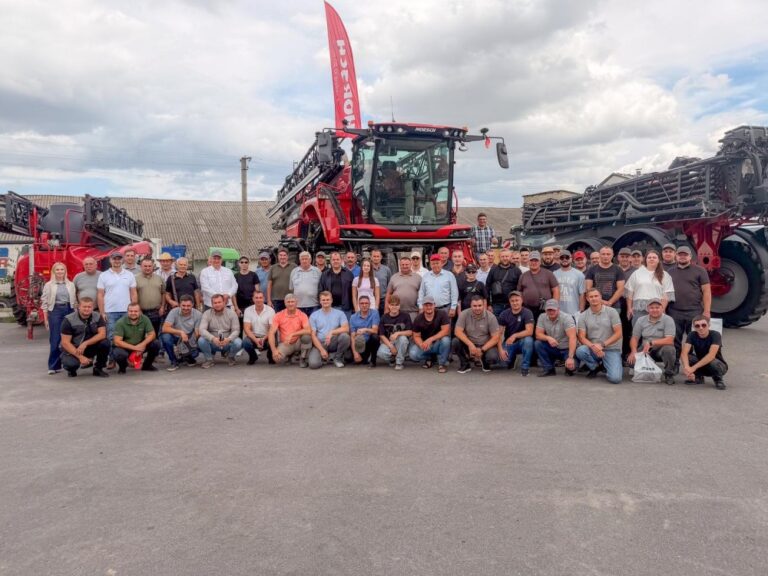
The Hydro Tour team at the “KWS-UKRAINE” plant in Kamianets-Podilskyi
Climate change leaves Ukraine’s farmers no choice and forces them to look for alternative solutions. One of them — irrigation. Together, we’ve looked at how irrigation systems work in different regions of Ukraine, and we know there’s a way out. It just needs to be found.