A Valley irrigation system in the field at “Promin”
Photo source: Latifundist.com
Together with partners, “Agro-Building Alliance “ASTRA”” and Valmont Inc. (maker of irrigation systems under the Valley brand), we continue the Hydro Tour across Ukraine, studying how farmers in different regions of our country use irrigation systems.
This time we visited “Promin” farm, part of the Western cluster of “Epicentr Agro,” in Letychiv district, Khmelnytskyi region. Corn hybrids are grown under irrigation here.

As usual, we turn to specialists at the “Meteo Farm” agri-weather service to ask about weather nuances in the region. According to their data, the wettest months were May and June, with 98.9 mm and 96.4 mm of rainfall respectively. The lowest rainfall was recorded in January, April and August.

As for temperature figures, the maximum temperature in Khmelnytskyi region was +35.2°C in August.

At “Promin” farm
On the second-to-last day of the Hydro Tour, the weather decided to throw us a surprise. Grey clouds followed us the whole way from Khmelnytskyi. As we approached the farm, the weather started deteriorating even further, so “Promin” Executive Director Oleh Havryshchuk, who met us there, decided, without wasting time, to head straight to the field.

Oleh Havryshchuk, Executive Director of “Promin”
Along the way, we learn the farm is involved in livestock farming, but views this project partly as a social one too, since it provides around 60 jobs for the population of nearby villages. The main line of business is crop production, in particular sunflower, wheat, and corn hybrids grown for Monsanto.
How the Southern Bug holds back the rain
As usual, we bring up the topic of climate change in Ukraine. Oleh Havryshchuk notes it’s affected Letychiv district too, since it sits at the junction of the climate zones of central and western Ukraine. Because of this, the district always gets less rainfall than the western regions.

“Over the past 5 years, we’ve noticed not only a significant drop in annual rainfall, but also a shift in the main seasons. While we used to get more rain in spring and autumn, over the last three years we’ve seen heavy rain in June, when moisture is needed but not as much as in spring for crop emergence, or in autumn during winter-crop sowing. Overall, we get around 260 mm of rainfall a year, and that’s very little for the crops we grow, especially corn.”
Oleh Havryshchuk
Executive Director of “Promin” farm
It was interesting to learn that the Southern Bug River, which flows through the farm’s territory, actually holds back rainfall. Our host has more than once watched rain reach the river and stop. But since a natural water source like the Southern Bug is right at hand, why not use it? So that’s what they decided to do.
They started using irrigation in 2017. The idea’s driving force was the holding’s head of agriculture, Vasyl Moroz. When he learned that irrigation had previously been used on this land for the feed base of a dairy farm, he got fired up about restoring the system.

The Valley irrigation system
Right now, 110 ha of corn is under irrigation. Next year, they plan to allocate 200 ha of corn and soybean for irrigation. Neighbours and colleagues from the agribusiness world have already visited the farm more than once to see the irrigation process for themselves, and many of them noted they plan to take this up seriously too.
Rebuilding the irrigation system
Oleh Havryshchuk notes that organizing irrigation is a complex process because of bureaucratic issues, namely processing all the necessary permit documentation. Plus you need to invest a lot in building the system. “Promin” farm got lucky in this respect, because they didn’t have to build from scratch, only rebuild the old irrigation system.
For that, they brought in specialists from ABA “ASTRA” at the initial stage. According to the Executive Director, the company’s offer won them over on price and quality. The specialists helped develop new design and budget documentation, selected the necessary equipment, supplied the farm with a motor pump and a Valley centre-pivot sprinkler machine, and carried out all the installation work.

“Promin” farm’s fields from a bird’s-eye view
This process was preceded by work clearing a 1.5 km drainage channel, through which water from the Southern Bug reaches the fields. Special equipment was used, letting them dig a trench 1.5 m deep. It’s exactly this depth that ensures water flows in at a rate of 65 l/s. Then another 1.5 km of pipe was laid from the motor pump to the hydrants. A power line runs nearby, which used to be used for irrigation, but the price the local electricity supplier offered was fairly high, and restoring the line would have required a substantial investment. So they decided against reviving it. All the work, from clearing the channel to installing the machine, took less than a month.
“The irrigation system was new to us, and we were worried about whether it would work well, whether there would be unforeseen situations we couldn’t handle ourselves. But in the end, we gained confidence in tomorrow, that we’d get a good harvest and, accordingly, good income.”
Oleh Havryshchuk
Executive Director of “Promin” farm
As Valmont’s territorial sales representative for irrigation equipment, Serhii Melnychenko, told us, Valley machines are supplied to Ukraine mainly from plants in the US and the UAE. The company also has plants in Brazil and South Africa. All of them are aimed at different markets. When one plant is at capacity and can’t deliver on time, machines are ordered from another plant.

“As for installation, a team of 5 people, using a front loader, can install a 400 m sprinkler machine in about 6 days.”
Serhii Melnychenko
Valmont’s territorial sales representative for irrigation equipment
Corn under irrigation
Deep in conversation, we hardly noticed arriving at the field where the DKS 4014 corn hybrid is grown under irrigation.
“This is one of the most successful hybrids for our territory: it releases moisture quickly, delivers a decent yield — potential within the range of 12-14 t/ha. On our commercial plantings, it delivers a yield in the range of 12 t/ha fresh weight, and about 10.5 t/ha in dry grain. That’s a pretty good figure, which is why we’ve stuck with this hybrid.”
Oleh Havryshchuk
Executive Director of “Promin” farm
But high yield isn’t the only important metric at harvest — genetic purity matters too, since the seed is then supplied to Monsanto. Both sterile and fertile hybrids are grown here. For the second year running, genetic purity stands at 98.8-99.5%. This year, for example, 28 people ensured genetic purity by manually detasseling the female plants.
The farm has its own weather station and soil moisture meters. It’s the readings from this equipment that determine the decision on how much water to apply to the field. A Monsanto consultant monitors plant condition in tandem with the farm’s agronomist.
The centre-pivot irrigation system
A 465 m Valley centre-pivot sprinkler machine stands in the field. When choosing the machine, they took into account not just the field’s shape but also how much water needed to be supplied to it. We were told that the centre-pivot machine can apply an average of 30 mm per day and cover 50 ha in a single pass. And although fields in Letychiv district have significant elevation changes, modern equipment handles even such complex terrain and irrigates fields regardless of whether they’re on high ground or in a low spot.
Another advantage of Valley machinery is that one machine can work off two hydrants. Over three days, the machine makes a full rotation, then it’s moved to another hydrant, and waters another 50 ha of field. There are plans to move the sprinkler machine to yet another hydrant, since they’ve seen this doesn’t harm either the equipment or the crops.

An irrigation system in the field
A crew of 6 handles equipment maintenance. For servicing the machines, they bring in “ASTRA” specialists. Oleh Havryshchuk notes their cooperation has been refined over years, so every issue gets resolved very quickly.
As “ASTRA” Valley irrigation systems sales group head Natalia Zhilnikova noted, the company is now launching a new development plan for the service line of business. Special attention will go to spare-parts availability.
Buying irrigation equipment: expensive?
Some companies, having an irrigation system left over from the Soviet era right at hand, aren’t in a hurry to rebuild it, considering it an expensive luxury. But if you dig deeper into the financial side of the question, there’s always a way to find a discount on the equipment.

The Valley irrigation system
“ASA “ASTRA”” has worked with OTP Leasing for a long time, which actively finances agricultural machinery sales. As part of this cooperation, a programme was developed providing farmers preferential financing terms.

“The programme provides for a reduced interest rate in hryvnia — from 7%, in foreign currency — from 0.4% in euro and 0.8% in dollars per annum, for a term of 1 to 5 years depending on the financing period and down payment size. Even accounting for generally low market rates, this is a more advantageous offer, because Valley, as the manufacturer of this equipment, is ready to partially compensate the financing interest rate a farmer receives.”
Yurii Kucherenko
Head of Small and Medium Business Sales at “OTP Leasing”
The down payment amount depends on the company’s financial reporting condition. If a company is financially strong and can service its debts, OTP Leasing can finance a deal with a 20% down payment. We also offer a unique product on the market, providing for a down payment increase up to 35% in hryvnia and up to 40% in foreign currency. At the same time, we don’t dig too deeply into the company’s financial analysis. We finance it even if it’s a startup, or has been on the market for less than a year and has no financial reporting. In other words, we have offers for any company.

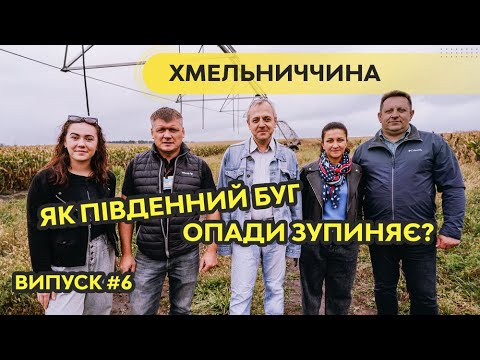
The Hydro Tour experts with Oleh Havryshchuk in “Promin”‘s field
Not goodbye…
During our conversation with “Promin”‘s Executive Director Oleh Havryshchuk, we heard an interesting thought:
“The weather has put everything in its place. You can’t treat land as just a platform for making money — it’s a living organism. This year showed, both in temperature and moisture terms, that it needs to be loved. Then it pays you back.”
Love and value your land.