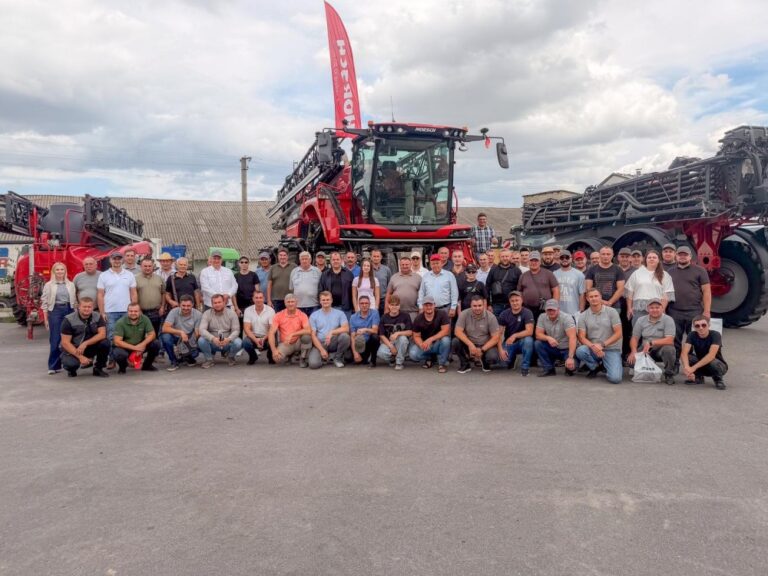
Among HORSCH’s newcomers in the crop-protection segment is a tandem trailed sprayer with a 12,000 l tank and a boom working width of up to 45 m.
Over the past few years, HORSCH has significantly grown its market share in the crop-protection machinery segment. Its product line-up has also expanded substantially.
TerraHORSCH: Mr. Leeb, what prompted you to create a tandem trailed sprayer?
Theo Leeb, head of HORSCH LEEB Application Systems GmbH: To be fair, it should be said right away that the tandem-chassis concept itself isn’t something entirely new. Machines like this have already been available on the market in a decent range for more than 20 years. From what we’ve observed, demand for this kind of equipment follows a sinusoidal curve, meaning it periodically rises and falls. A large tank volume lets you increase output by reducing the number of stops for refilling, and it’s an advantage with fields spread far apart. On flat terrain and light soils, the machine’s fairly high weight isn’t a particular problem even at higher moisture levels. On strongly uneven terrain and heavy soils, on the other hand, this equipment has its limits, given the increased need for pulling force and excessive soil compaction. Manufacturers try to solve these problems using traction-optimization systems or axles adjustable for width and height….

The boom is available with 5 or 7 sections.
Does this effectively solve the problems?
Only partly. The core of the problem is this type of machine’s design, with a long, narrow tank, where liquid migrates to the rear while climbing a slope, reducing the support load. As a result, the load on the tractor’s rear axle and its pulling force decrease. Increasing the tractor’s rear ballast is counterproductive – it just adds to the unit’s overall weight, contributing to deep ruts forming in the field. All these factors combined give tandem sprayers a fairly narrow niche on the market.

The axle-load problem typical of tandem sprayers was solved on the HORSCH Leeb 12 TD by installing a dual tank.
Which part of that niche do you want to capture…?
We ran a thorough analysis. In Germany, tandem sprayers are common, above all, in the north and east of the country, where large agricultural enterprises predominate. In Eastern European countries, under similar conditions,
smaller trailed or self-propelled sprayers are currently preferred. In my view, this is explained by the makeup of farms’ tractor fleets, where in most cases the niche in the 250-300 hp range, between small traction-class tractors like the MTZ and powerful tractor units, remains unfilled. On the other hand, there’s also a growing labour shortage, which, in our view, will drive greater interest in larger machines. The HORSCH Leeb 12 TD is a good alternative to self-propelled machines, especially given its high working clearance (up to 1.35 m), which allows late-season treatment of tall-stemmed crops like corn or sunflower. For tending other crops, the working clearance figure matters less, and what comes first is a large
working-tank volume, letting you substantially boost output. What’s more, the 12 TD is no slower than self-propelled models either. I’ll also mention the mandatory presence of the BoomControl automatic boom-guidance system. All these capabilities combined are what prompted us to bring a new machine to market.
Despite the problems you mentioned above …?
The priority task was solving the negative-axle-load problem. This was achieved by using a dual tank with a combined 12,000 l capacity, split 7,000 l at the front and 5,000 l at the rear. Both tanks are connected to each other, which avoids one of them overfilling. In spraying mode, both tanks empty gradually, but the front tank
always retains more liquid than the rear one. The two tanks also have an important advantage when climbing a hill, since it prevents a situation where a large amount of liquid shifts to the rear. As a result, the support
load on the tractor’s hitch is always kept in an optimal range, which increases its pulling force. Because of the even axle-load distribution, all four wheels are equally loaded at any given moment. That’s what explains our “tandem”‘s low draft resistance.
But what about the working-solution concentration in both tanks? Is it really always the same?
Absolutely! And that’s without any sensor technology or electronics at all. Already when filling, we fill the tanks with water in a 7:5 ratio, so it’s possible to add the corresponding amount of plant-protection product. We also use a special homogenizer to mix the solution. The pump’s 1,000 l/min output plays a big role here. Mixing the solution
is also very important when we’re working with products in powder or granule form.
But two tanks have a much larger surface area in contact with the working fluid…. Does that affect how well it can be cleaned?
On the contrary. It’s hard to grasp, but the effective cleaning area in our two-tank system is actually smaller. The thing is, all large-volume tanks have built-in internal baffles so the liquid doesn’t slosh around while driving. In most cases, these are zigzag-shaped surfaces with a large area running across the tank, which are very hard to clean. By using two tanks instead of one, we managed to do away with internal baffles entirely.
How many HORSCH Leeb 12 TD variants are you planning?
There will be two tank variants: stainless steel and polymer. Boom designs will be offered across just as wide a range as for other models – from 5 to 7 sections with a working width of up to a maximum of 45 m. Nozzle spacing of 25 or 50 cm. The serial Boom-Control will allow spraying at a target distance of 30 cm. The liquid system will be offered in two variants: CCS Pro will let you control all of the machine’s functions both from an external terminal and from the tractor cab. Continuous sequential cleaning is included. As an alternative, a budget ECO CP version will be offered with a powerful centrifugal pump and standard cleaning. As for the chassis, the plan is either active steering on both axles, or a combination of a rigid front axle and a passively steered rear axle.
How do you assess the sales potential for a product like this?
The HORSCH Leeb 12 TD is meant to become the flagship of our trailed sprayer line-up. I see the most promising markets for these machines in the north and east of Germany, as well as in Eastern European countries. But
I wouldn’t write off the prospects in North America either. Paired with a powerful tractor, the 12 TD’s speed is comparable to a self-propelled machine, and the tank volume is much larger. That’s output, an advantage when working with high application rates, and it’s also convenient if fields are spread over a wide radius. The wheel diameter deserves special attention – and let me remind you, that’s 2.05 m! As for pricing, the main difference will come down to the tank material. For the 12 TD with a polymer tank, we’ll aim for the equivalent of the 8 GS with a stainless-steel tank.
When will it be possible to order the new tandem sprayer?
The first 5 machines will arrive in spring, and from August 2020 we’re planning our first limited series.