Vegetables under irrigation in Cherkasy region
Photo source: Latifundist.com
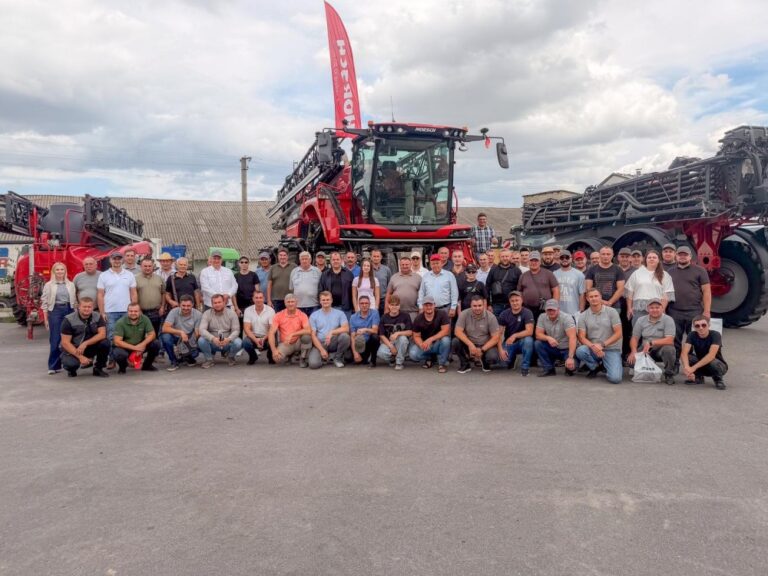
The Hydro Tour across Ukraine’s regions continues. This time, together with our partners, “Agro-Building Alliance “ASTRA”” and Valmont Inc. (maker of irrigation systems under the Valley brand), we came to Chornobai district, Cherkasy region. This is where the “Dnipro” agro-industrial corporation is located — the region’s largest vegetable producer. It’s a family enterprise, run by an entire dynasty. The father — Petro Hryhorovych Dusheiko and his sons Andrii Petrovych, Hryhorii Petrovych and Oleksii Petrovych.
The company’s produce is known well beyond the region, since it’s supplied to supermarkets in Kyiv, Odesa and Zaporizhzhia. Every year, it sells 15,000-17,000 tonnes of vegetables on the Ukrainian market. So it’s entirely possible that at some point, we’ve all bought cabbage, beets and carrots for borsch grown in Vasiutyntsi village.

An irrigation system in the field at “Dnipro” agro-industrial corporation
How does the company manage to get harvests in one of the driest regions? This year, for example, throughout the whole summer, normal rainfall was only seen here in May and June. According to specialists at the “Meteo Farm” agri-weather service, 111.7 mm and 60.4 mm fell respectively. August was thin on rainfall, with just 7.7 mm.

The region’s maximum air temperature was recorded in September at +37°C.

It turns out that even in such conditions, it’s possible to grow vegetables and grain crops if you approach the technology thoughtfully and love what you do. Let’s look at the farm’s experience together.
A farming dynasty
The “Dnipro” agro company has existed in Vasiutyntsi for over two decades. The Dusheiko family has run it this whole time. The head of the family, Petro Hryhorovych, started his career at the local school, where, incidentally, his wife also worked. Later he headed the collective farm in Vasiutyntsi.

Andrii Dusheiko, head of “Dnipro” agro-industrial corporation
His sons followed in their father’s footsteps. The eldest, Andrii, studied to be an agronomist, interned in France, and defended his PhD dissertation. The middle son, Oleksii, studied mathematics at Cherkasy National University, then went on to the finance and economics faculty at Cherkasy State Technological University. The youngest, Hryhorii, graduated from the economics and management faculty at Kyiv National University of Food Technologies. He also has a second degree, in law.
What does the company do?
The “Dnipro” group of companies has a land bank of 15,000 ha. They grow:
- corn (around 6,000 ha);
- silage corn (around 500 ha);
- winter wheat (around 2,500-3,000 ha);
- sunflower (2,500 ha);
- spring barley (around 2,000 ha).
But the farm is best known for its success in vegetable growing: 350 ha is set aside for borsch-set vegetables, of which 55 ha is for cabbage, 60 ha for table beets, and the remaining land is split between onions, carrots and pumpkin. Seed of foreign breeding is used for sowing.
The harvested produce is stored in 6 vegetable-storage facilities. Three of them are fitted with cold-storage chambers, holding 3,000 tonnes each, letting produce be stored through May-June. At the time of our visit, carrots were being stored in the chambers. The other three vegetable-storage facilities are fitted with active ventilation systems and are rated for 5,000 tonnes each.
Another line of business is livestock farming. The agro corporation has 3,500 head of cattle, 1,400 of which are dairy cattle. But for the company, this line of business doesn’t bring in much profit and is more of a social project, since it provides jobs for the local population. Plus, producing organic fertilizer from it helps improve soil fertility.

When did they switch to irrigation?
“Dnipro” group of companies co-founder Oleksii Dusheiko told us about when the company decided to switch to irrigation. According to him, trunk pipes were laid to the fields back in the 1980s. But in the ’90s, the irrigation system in the region wasn’t used, and there were “resourceful” types who cut those pipes for scrap metal. Back then, the Dusheiko family teamed up with like-minded neighbours and began guarding the fields day and night. This way, they managed to preserve the trunk line and, by the early 2000s, brought it into operation. Now vegetables here are grown only under irrigation.

Oleksii Dusheiko, co-founder of “Dnipro” group of companies
“Growing vegetables without irrigation is a gamble. There’s no talking about any kind of industrial production. First, groundwater sits very low. Second, drought has been gathering pace in recent years,” says Oleksii Dusheiko.

At first, they used “Volzhanka” self-propelled sprinkler machines, a leftover from the Soviet era. Then, some time later, they bought two Valley irrigation machines, which can service 100-120 ha of fields. They also use drum-type machines with cannons (the company has 10 of these).
“Our water is supplied by a pumping station located on the bank of the Kremenchuk Reservoir. We have a partnership relationship with the water supplier, a state enterprise. There are no supply problems. As for payment, it depends on how much water was used. We’re talking about around 1 million hryvnia a month.”
Oleksii Dusheiko
co-founder of “Dnipro” group of companies
Cabbage plantations
A line from Lidiia Povkh’s well-known children’s poem about “Oh what a cabbage” — describes exactly the cabbage growing in “Dnipro” group of companies’ fields. That’s 55 hectares of green, crisp vegetable with perfect heads. Of that, 40 ha is set aside for a late variety, which will later go into cold-storage chambers and can be stored right through spring.
A self-propelled Valley sprinkler machine stands along the entire field. According to Oleksii Dusheiko, its main advantage is that it lets you adjust the water application rate, whereas, for example, drum-type machines lack that function. Ahead of the season, the farm prepares an irrigation process map for each crop. To do this, a soil analysis is carried out under lab conditions. The application rate is then adjusted based on rainfall and air temperature. Cabbage here is watered twice a week. Beforehand, the agronomist inspects the plantings.

A self-propelled Valley sprinkler machine stands along the entire field
As “ASTRA” Valley irrigation systems sales group head Natalia Zhilnikova notes, irrigation isn’t a magic wand you can wave to get a high yield. In reality, irrigation should be seen as part of the technological process.

Natalia Zhilnikova, “ASTRA” Valley irrigation systems sales group head
“If the technology is built incorrectly or fails, the yield won’t increase. Yes, it’ll be at a decent level, since the plants will get additional moisture unlike those growing on rain-fed land. But maximum yield can only be achieved through properly built technological processes on the farm,” comments Natalia Zhilnikova.
Weather catastrophes
Another self-propelled Valley machine, at the time of our visit, was working a 60 ha field growing table beets. “Life wasn’t a bed of roses for the beets this year,” Oleksii Dusheiko reflects philosophically. What kept the vegetable from developing normally was a hailstorm on July 4.
“Before the hail, the plants were developing well and had grown 5-7 cm. But after that kind of weather catastrophe, they needed 2-3 weeks to recover. We applied extra feeding and watered. Now the beets have a marketable look, but the harvest will have to happen later. It’s the same situation with the pumpkin, which we’ve set aside 35 ha for. If harvest used to start September 5-10, this year, by early October, it’s not ready for harvest: it doesn’t have the necessary colour and hasn’t built up sugar. And frost is coming soon. So there’s a risk of getting a non-marketable-looking harvest.”
Oleksii Dusheiko
co-founder of “Dnipro” group of companies
Onion fields also suffered from the hail. In the end, the farm got only half its expected harvest. This vegetable is grown here under drip irrigation. As for corn, drought became the critical factor. As Oleksii Dusheiko notes, he hasn’t had such a low yield in his 21 years of work.
Drought also affected winter-crop growing. To minimize risks and guarantee winter-wheat emergence by winter, part of the sowing began being grown on irrigated land. For this, the field is watered before and after the sowing campaign wraps up. This year, 450 ha was sown this way.
Vitamins for cattle
We move with our interlocutor to a neighbouring 40 ha field, where oilseed radish was sown after winter wheat was harvested.
“When we harvested the winter wheat, we decided to ‘treat’ our cattle herd to some vitamins. You can see it’s already flowering. This plant is a nectar source. There’s an apiary nearby, and the bees can supply themselves with nectar. We mow about a hectare and a half daily, and this way we supply the farms with green mass. It turns out that under irrigation, you can get two harvests,” Oleksii Dusheiko shares.

An oilseed radish planting
According to him, they wouldn’t be able to grow radish in such weather conditions without irrigation. As proof, Oleksii takes us to the edge of the field, where the sprinkler machine doesn’t reach — the radish leaves there have withered from the heat.
Service
As usual, at every farm we visit, we ask whether it’s hard to service the sprinkler machines. After all, buying and transporting a machine to the field is one thing, and running it for the whole season is another.

The Valley irrigation system
Oleksii Dusheiko said Valley equipment has proven itself well. But the farm did run into delayed spare-parts delivery. “ASTRA” Valley irrigation systems sales group head Natalia Zhilnikova noted that as soon as the company found out about this problem, they quickly ordered the part and did everything possible to get the system running again as fast as possible.

“We worked through it and are launching a new development plan for the line of business. We’re paying special attention to spare-parts availability and having qualified service support.”
Natalia Zhilnikova
“ASTRA” Valley irrigation systems sales group head
Asked whether “Dnipro” plans to buy more machines like this in the future, Oleksii Dusheiko said the company’s management is thinking about expanding the irrigation system, even though it isn’t cheap. Given the climate challenges seen today not just in Cherkasy region, but across all of Ukraine, it’s quite possible they’ll eventually have to switch fully to irrigation. But that’s a lengthy process even with good financing, our host noted.
Buying machines: financial instruments
In turn, Valmont’s territorial sales representative for irrigation equipment, Serhii Melnychenko, added that systems are selected individually for each farm. To do this, company staff visit the farm to see for themselves where water will come from to the fields, what crops will be grown under irrigation, and what agricultural technologies are used. Accounting for the agro-climatic zone and soil analysis, they calculate the average daily application rate for each crop.

Serhii Melnychenko, Valmont’s territorial sales representative for irrigation equipment
“ASTRA” has worked with “OTP Leasing” for a long time — a universal leasing company that’s part of the European OTP Group financial group. As part of this cooperation, customers get preferential financing, in particular, a reduced interest rate in hryvnia — from 7%, in euro — from 0.4% and in dollars — 0.8% per annum, for a term of 1 to 5 years, depending on the financing period and down payment size.

“The down payment amount depends on the company’s financial reporting condition. If the company is financially strong and can service its debts, we can finance a deal with a 20% down payment. We also offer a unique product on the market, providing for a down payment increase to 35% in hryvnia and up to 40% in foreign currency. At the same time, we don’t dig too deeply into the company’s financial analysis. We finance it even if it’s a startup, or it’s been on the market for less than a year and has no financial reporting. In other words, we have offers for any company.”
Yurii Kucherenko
Head of Small and Medium Business Sales at “OTP Leasing”

An irrigation system in a cabbage field
A lessee can choose the financing currency and the timing of the main payments, for example, periods when produce prices are highest. Other key advantages of financial leasing include getting a tax credit for the full cost of the machinery immediately after making the down payment and signing the equipment handover certificate.
An enviable village
Our team, after also inspecting a carrot field where manual vegetable harvesting was underway, headed home. Along the way, we couldn’t help but note the beauty of Vasiutyntsi village. Located on the left bank of the Dnipro, on the border of Cherkasy and Poltava regions, it’s surrounded by greenery. In the centre, on a 4 ha plot, sits a beautiful arboretum, home to more than 300 plant species. It probably won’t surprise anyone that the Dusheiko family are the arboretum’s caretakers. The village also has a school and a hospital, and a church. Say what you like — an enviable village!