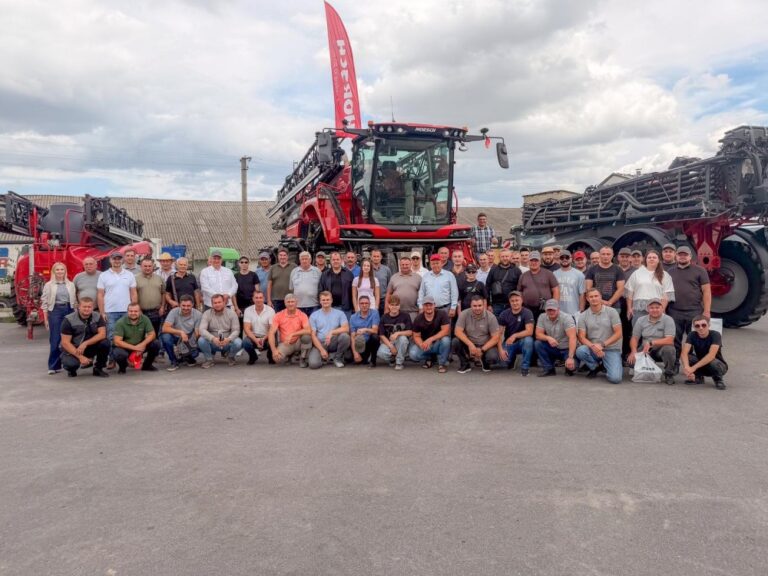
Photo source: Latifundist.com
Together with our partners, “Agro-Building Alliance “ASTRA”” and Valmont Inc. (maker of irrigation systems under the Valley brand), we continue the Hydro Tour across Ukraine, learning together with you the nuances of using irrigation systems in different regions of the country.
The journey started in the southern regions, and gradually we made our way to Central Ukraine. Meet today’s episode’s hero — the “Bioteh LTD” farm, located in Boryspil district, Kyiv region. Here, potatoes and corn are grown under irrigation on part of the acreage. Why they decided to adopt irrigation, what problems they ran into, what yields they now get — we’ll cover all of that below. But first, let’s see what the weather was like in the region: did it treat farmers to rainfall?
According to specialists at the “Meteo Farm” agri-weather service, the “wettest” month was May, with 129 mm of rainfall, and the driest were January and August, with 12.3 mm and 14.8 mm respectively.

The average air temperature across the region over nine months came to +22°C. The hottest month was September, with a maximum temperature reaching +36.6°C

Irrigation at “Bioteh LTD”
An hour’s drive from Kyiv — and we’re at “Bioteh LTD,” with a total land bank of approximately 2,000 ha. Crop number one is potatoes. The farm works closely with the Institute of Potato Growing and grows elite seed-potato varieties. For this, it has its own bio-lab, a greenhouse complex and propagation plots. It’s also the main potato supplier for “Chips Lux.”

The “Bioteh LTD” farm
Irrigation has been used here since 2000. Potatoes and corn are grown under irrigation every year. According to General Director Anatolii Bykin, the farm has drum-type machines and some front-type machines made by Valley for this.

“When we first started growing potatoes, we understood that irrigation is a guarantee that even in critical years, we’ll get the necessary yield level of the required quality”.
Anatolii Bykin, General Director of “Bioteh LTD”
Build up and preserve
It’s worth clarifying here that our host holds a doctorate in agricultural sciences, is a professor and corresponding member of Ukraine’s National Academy of Agrarian Sciences, has 30 years of teaching experience, and combines production practice with work at Ukraine’s National University of Life and Environmental Sciences. During the tour of the farm, he noted that irrigation isn’t a “cure-all for every failure” – it needs to be used as a supplement to natural moisture. First you need to build up natural moisture in the soil, then preserve it and use it rationally. But if these three points don’t work out, then irrigation can be given as a supplement. And to build up moisture, you need to correctly choose your soil-cultivation technology, crop rotation and cover crops.
In Anatolii Bykin’s view, on any farm, irrigation should be part of the agricultural technology. Kyiv region has complex terrain. If you pour a lot of water on high ground, there’ll be a swamp in the valley. And soils vary from field to field in moisture capacity and productivity — the lighter the soil, the more often it needs watering, but at a smaller rate. So it’s important for the agronomy team to understand what water rate to give the plants on a specific plot.

Dmytro Zhmak, leading sales manager for Valley irrigation systems at ASA “ASTRA”
The leading sales manager for irrigation systems in southern Ukraine, Dmytro Zhmak, agrees with this view. He noted that the entire irrigation system should be selected accounting for the farm’s soil types.

“You can’t apply more water than the soil can absorb. But not every agricultural producer understands this and believes that the more you apply, the higher a yield you can get. Flooding a field won’t do the plant any good — puddles form, the soil becomes waterlogged, the plants start getting sick, and the farmer has to spend extra on plant protection products. So when we arrive at a farm, we build a chart and explain to the customer that, given the soil, they need to water at such-and-such a rate.”
Dmytro Zhmak, leading sales manager for Valley irrigation systems at “ASTRA”
The challenges of irrigation…
When our team was getting ready to head to the field to see the sprinkler machines at work in person, Anatolii Bykin laughed and said: “You should have let us know in advance that you were planning to visit.” Seeing the confusion on our faces, he added that the farm gets its water from the Bortnychi irrigation system, but it needs to be ordered 2-3 days in advance.

Anatolii Bykin, Director of “Bioteh LTD”
“We start negotiating with the organization that supplies us with water at the end of February or early March. The negotiations end with signing a contract that spells out the supply schedule and payment. Then we submit a request that we need a certain amount of water on a certain day. And it’s supplied within 2-3 days. It takes two days for the water to reach us from the station,” Anatolii Bykin explains.
He also added that irrigation in Boryspil district was already used back in Soviet times. When the farm was just starting to operate in this region, it saved the equipment from being scrapped for metal. Today, the situation is such that it not only pays for the water, but also monitors the cleanliness and working order of the canals, and replaces pipes and carries out repairs with its own resources.
“The number of sprinkler machines depends not just on the farm’s financial capabilities, but also on how much water is supplied to the farm. We can only take water from the Dnipro,” notes the General Director.
Potato irrigation technology
We approach the fields. On one, potato harvesting is underway — clouds of dust rise from the machinery at work, while on another — harvesting finished long ago and a cover crop (oilseed radish) has been planted. As “Bioteh LTD” Chief Agronomist Serhii Zhereb told us, early potato varieties are harvested July 3-15. After that, cover crops are sown on the field. Most often radish, but this year on one field they sowed millet and expect to get a second harvest under irrigation. Cover crops help replenish the soil’s humus reserves. Besides that, these plants’ root systems loosen the soil layer and promote oxygen penetration.

“We mainly grow potatoes under irrigation. Growing potatoes for chips and french-fry production without irrigation is impossible in our climate conditions, since these varieties are prone to secondary growth (due to drought, secondary tubers form on the eyes — ed. note). Besides that, irrigation lets you get a higher yield per hectare than on rain-fed land”
Serhii Zhereb, Chief Agronomist at “Bioteh LTD”

The irrigation system
After the cover crops are harvested, potassium fertilizer is applied to the field and deep tillage is carried out. Manure hasn’t been applied since 2010. Crop residue serves that role instead. In spring, part of the nitrogen fertilizer from the overall application scheme is applied to the soil, and moisture is sealed in using special implements. Before planting potatoes, primary tillage is carried out. Serhii Zhereb also noted that the farm runs a great deal of research on localized band application of potassium and phosphorus fertilizers. After these operations, potatoes are planted — usually in the first-second ten-day period of April and the first ten-day period of May.
When the plant reaches 15 cm in height, depending on the variety, watering begins. Watering continues throughout the whole growing period. In the past, plants were watered three times a season here: during budding, flowering and tuber formation. But weather conditions have made their own adjustments — now there can be more waterings in a season, at a rate of 25 ml of water.
Choosing a sprinkler machine
The farm used to use drum-type sprinkler machines. But they were low-output, so after watering, a crust formed on the surface that didn’t let air into the soil. Over time, water stopped penetrating the tillage layer at all and just sat on the surface. So in 2005, the farm decided to gradually switch to front-type sprinkler machines. First they bought a machine made by Bauer, and in 2010 — a Valley. The latter proved itself well, and two years later the farm got another one of these units.

A Valley sprinkler machine
“The advantage of the Valley front-type sprinkler machine is that it waters the field more evenly, doesn’t harm the crop, and is convenient to transport from one field to another. Potatoes need to be watered very quickly, and a machine like this will water a 30 ha field in 2 days. You also need to choose the machine to fit the field’s configuration. It’s more convenient for us to travel across the ridges, so we chose a front-type machine. But for watering corn, wheat or sunflower, centre-pivot machines are ideal,” Serhii Zhereb says.
Another advantage is the ability to apply fertilizer. A few years ago, the farm bought a fertigation system and now applies nitrogen fertilizer not just on the potato plots, but also on the fields with corn hybrids.
On machine servicing
Serhii Zhereb also clarified that four factors were taken into account when choosing the machines:
- the crop that will be irrigated;
- the field’s configuration;
- the unit’s technical specifications;
- availability of service support.
And the last factor was one of the most important.
“We’re happy with the service. Even if we need some part on a day off, it gets supplied right away. It’s also worth noting how fast the machines are delivered and installed. It took the company just a few days,” the agronomist noted.
Valmont’s territorial sales representative for irrigation equipment, Serhii Melnychenko, added that the timeline for installing one machine depends on the scope of work involved.

Serhii Melnychenko, Valmont’s territorial sales representative for irrigation equipment
“A crew of five people and one front loader can install a 400 m machine in about 5-6 days,” he explains.
Meanwhile, according to Valmont’s technical manager for CIS countries, Borys Rubtsov, over more than 70 years working in the irrigation equipment market, the company has learned not just to manufacture machines, but to service them well too.
“We maintain feedback with all our customers, and they know who to call in case of a breakdown,” Borys Rubtsov says.
In turn, “ASTRA” Valley irrigation systems sales group head Natalia Zhilnikova added that to respond to customer requests even faster, the company plans to open its own service points in the regions.

“These service centres will have parts warehouses, and a service engineer will be on staff. We’re now compiling a list of spare parts that should be in stock during the irrigation season. Today, many farms are running machines that are already 10-12 years old, so they’re no longer under warranty. So spare parts are needed. And they need to be delivered to customers as fast as possible, since a day of machine downtime during the season costs farmers dearly.”
Natalia Zhilnikova, “ASTRA” Valley irrigation systems sales group head
She also noted that the standard warranty on new machines is two years from the date they’re commissioned. Starting this year, it’s become possible to get an extended warranty of up to 5 years, provided a service contract is signed.
As for irrigation equipment payback, it depends on which crop is being irrigated at the farm. Machines used for watering vegetables pay back fastest, notes “Bioteh LTD”‘s General Director.
Here we should note that “ASTRA” has worked with OTP Leasing for a long time, which actively finances agricultural machinery sales. One of the advantages of this cooperation is the partner financing programme. It provides for a reduced interest rate in hryvnia — from 7%, in foreign currency — from 0.4% in euro and 0.8% in dollars per annum, for a term of 1 year and up, depending on the financing period and down payment size.
“Even accounting for generally low market rates, this is a more advantageous offer, because Valley, as the manufacturer of this equipment, is ready to partially compensate the financing interest rate a farmer receives,” noted OTP Leasing Head of Small and Medium Business Sales Yurii Kucherenko.
Farmers also have the option of getting additional compensation for the equipment’s cost from European organizations.

“We work closely with the European Bank for Reconstruction and Development, which provides targeted financing for small and medium agribusiness. For example, last year, participants received 10% of the financed amount as a grant from the EBRD.”
Yurii Kucherenko, OTP Leasing Head of Small and Medium Business Sales
What package of documents is required to sign a contract? Compared with getting a bank loan — a very small one. For OTP Leasing to make a financing decision, a company’s financial statements for a few operating periods are enough.
The winter will be warm, but with frosts…
Our visit to “Bioteh LTD” was already drawing to a close when we brought up the topic of climate change and the challenges farmers now face. To which General Director Anatolii Bykin noted he’s been friends for many years with folk weather forecaster Leonid Horban and orders a seasonal weather forecast from him. What’s interesting is that the forecast comes true 70-80% of the time. According to our host, this way he roughly knows in advance which hybrids will be sown in the fields, which fertilizers will be applied. Well, forewarned is forearmed. In parting, we’d like to wish the farm a bountiful 2021. As for us, we’re heading off again, since they’re already waiting for us in Cherkasy region.