In agricultural production, no new year is quite like the one before. Even so, changing climate conditions are bringing an unpleasant stability to the work of farmers. Droughts in Ukraine are becoming frequent and are spreading to new territories. Because of accumulated problems with the irrigation system, farmers aren’t managing to adapt to climate change in time.
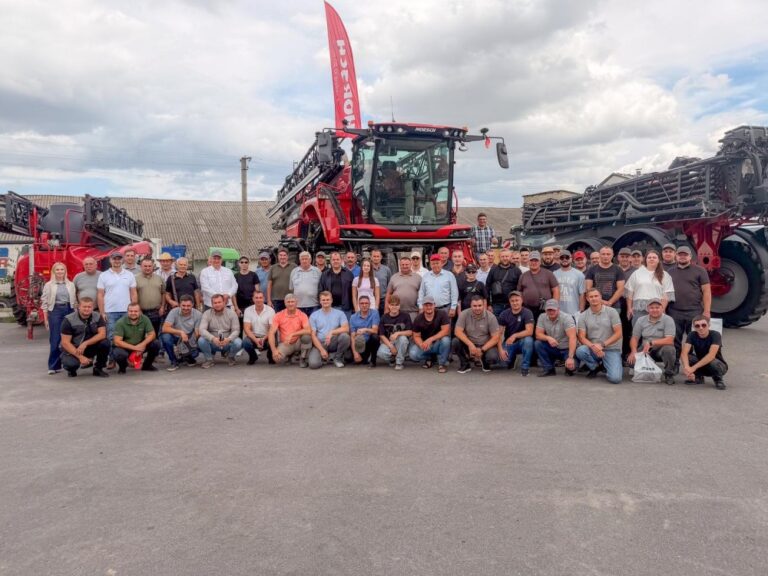
On September 3, Latifundist.com began its first hydro-tour together with “ASA Astra”, which markets Valley irrigation systems on the Ukrainian market. As part of the project we’ll visit farms in Kherson, Zaporizhzhia, Dnipropetrovsk, Kyiv and other regions, and talk about the specifics of growing various crops using irrigation.


A dry year
Meteorologists say, without irony, that we’re living in a period when natural anomalies are becoming the norm. This year, starting in January, every month (except May) has seen an elevated temperature background in the country, with monthly averages running well above normal. According to the Agrometeorology department of the Hydrometeorological Center of Ukraine, in January-February the temperature ran 6° above normal, and in the summer months 2-3° above normal. Specialists say that even if there had been rainfall, it couldn’t have offset such temperatures.
But there was also very little rain. According to the Agrometeorology department, the least precipitation since the start of the year fell in April — 30% of normal. In many districts of the country’s central regions there’s been no rain since July. In some regions the drought has continued since late May. Total precipitation for June-August didn’t exceed 30-50% of normal in many districts of Kyiv, Cherkasy, Vinnytsia, Kirovohrad, Chernihiv, Kharkiv, Dnipropetrovsk, Donetsk, Odesa and Mykolaiv regions. According to MeteoFarm monitoring, in August total precipitation in Odesa region was only 4 mm, and in Mykolaiv and Kirovohrad regions — 6 mm.
«In 2019-2020, autumn and winter were very dry. The country hasn’t seen a fall-winter period like this in the last 120 years. In many regions of Ukraine — and not just the south — almost no precipitation fell in spring; summer rains, where they occurred, were very heavy but over a short span of time. That is, they can’t be called effective. All of this affected soil moisture reserves», — noted Dmytro Zhmak, lead sales manager for Valley irrigation systems at “ASA Astra”.

Dmytro Zhmak, Valley irrigation-systems sales manager at “ASA Astra”
As of August 20, in the country (except the western regions), the topsoil layer under nearly all crops was almost dry or completely dry. According to MeteoFarm, for instance, in August soil moisture in Odesa and Mykolaiv regions was only 9%. Cherkasy, Poltava, Dnipropetrovsk, Kherson, Zaporizhzhia and Luhansk regions weren’t far behind, either. In these regions soil moisture in August stood at 11%. Across large areas of central and southern regions, specialists note the complete drying-out of the meter-deep soil layer under late-season crops.
Odesa region was hit hardest this year (more precisely, it’s suffering for the second year running). Specialists say no other region of Ukraine has seen anything like Odesa region (especially in the south), where the drought lasted 12 months and conditions for agriculture were, without exaggeration, catastrophic.
«So, the elevated temperature background from the start of the year, high air temperatures in July (+35-41°), and insufficient rainfall — all of this led first to an atmospheric, then an atmospheric-soil drought in Ukraine», — summed up Tetyana Adamenko, head of the Agrometeorology department at the Hydrometeorological Center of Ukraine.
By the end of August, meteorologists reported an intensification of the air-soil drought across most of Ukraine’s territory. This was driven not only by high air and soil temperatures, but also by dry winds. Specialists call dry winds “the death of the harvest”, since they can destroy what’s been grown in just two days. Fortunately, Ukraine had no dry winds in the academic sense — dry winds exceeding 5 m/s combined with low humidity and high temperature. But specialists did note dry-wind-like phenomena this year, i.e. weaker manifestations of dry winds. They were observed continuously for 30-35 days in June-July, which also contributed to the premature halting of crop growth and development.
The drought significantly worsened conditions for forming a full-fledged harvest of late-season crops, and led to a slowdown and premature end of growth for sunflower heads and corn ears.

According to Tetyana Adamenko, back at the start of summer, market participants had good prospects for the corn harvest. The crop was sown mostly in late April-early May, and May saw decent rains. But the high summer temperatures dashed hopes for a record harvest. Corn crops saw unsatisfactory pollination, and a significant number of nearly empty ears formed.
«In week 2-3, corn simply stopped growing and developing altogether, and, as it were, prematurely formed its yield. Naturally, it couldn’t be a large one. Because every crop has its own length of growing season. And if that period is cut by a third, then it’s clear the harvest will shrink by a third too», — explained Tetyana Adamenko
Overall, the situation across the country is uneven. In the western regions of the country (where moisture is better and temperatures lower), a good corn harvest remains likely. In the southern and eastern “non-corn” regions of Ukraine, which never had high yields of this crop anyway, a yield of 3-3.5 t/ha is forecast. As Tetyana Adamenko said, in Dnipropetrovsk region they’d expected to harvest 4 t of corn per hectare, but it’s already clear expectations won’t be met. Of the corn belt, the central regions have suffered most this year: Poltava, Cherkasy, Kirovohrad, Kyiv.
According to specialists at “ASA Astra”, growing corn without irrigation is impossible in southern Ukraine. With irrigation you can get 10, even 12 t/ha.
Farmers will also harvest less sunflower this year than expected. Specialists say sunflower is now “burning” more in the east than in the south of the country. That’s because the east has higher temperatures and less rainfall. And farms that had counted on 3 t of sunflower per hectare are now talking about 2-2.5 t/ha.

Irrigating sunflower crops
In addition, in late August meteorologists said that critical conditions for timely sowing of winter rapeseed are developing across almost the entire country (except the western regions), since there’s no moisture accumulation in the soil for the 2021 winter grain crop.
Irrigation systems. Chances for restoration
So, this year once again proved the accuracy of forecasts that by 2030-2040 it will be practically impossible to farm without irrigation in the south, and perhaps even the central regions of Ukraine.
«Ukraine’s agricultural sector already needs stable irrigation and quality watering systems today. This axiom is proven by obvious climate factors and by Ukrainian farmers’ desire to get the maximum yield from their moisture-starved land», — believes Dmytro Zhmak, a specialist at “ASA Astra”.
Irrigation makes it possible to grow various crops and get a yield increase of 50% to 250%, depending on the crop. And the biggest plus of watering is considered to be the chance to get 2 harvests a year. As for investment, according to specialists at “ASA Astra”, irrigation-machine purchases can pay for themselves within 2-5 years. Growing potatoes has a 2-year payback period, corn — 3-4 years, sugar beet — 2 years.
«We take a very careful approach to selecting our partners and suppliers. ASA “Astra” is the official dealer of Horsch, Berthoud, Fendt, Valtra, Manitou, Valley, Bogballe. It’s important to us to work with the best and most innovative brands. Our portfolio brings together brands you can be proud of. Irrigation systems from the Valley brand (Valmont inc.) are no exception. Valley — the world leader in the production and sale of pivot and linear irrigation. “Astra” has partnered closely with Valmont inc. for more than 10 years. Together we’ve implemented more than two hundred irrigation projects using Valley-brand systems across the whole territory of Ukraine. For many farmers, 2020 became a year of trials. Not only the pandemic, but nature too brought many unpleasant surprises for our farmers. That’s precisely why, together with Valmont inc. and our financial partners, we’ve developed and prepared a number of financial programs to support our clients. We can offer a wide selection of programs with various down-payment options and financing terms from 1 to 5 years. There are also individual programs, specially developed to fit an enterprise’s needs. And most importantly — the time needed to decide on financing has been cut to a minimum. To get our offer, you simply need to visit our website and contact our representatives in your region», — says Ihor Gubarev, CEO of ASA “Astra”.

Ihor Gubarev, CEO of ASA “Astra”.
For their part, irrigation-system suppliers try to provide farmers with every possible financial instrument to make the equipment more affordable. Notably, “ASA Astra”, which markets Valley irrigation systems on the Ukrainian market, recently launched a joint preferential-financing program with “OTP Leasing”.
«This is a new direction for us, but we see great prospects in it. So far the company, whose portfolio stands at $385 million, or 42% of the leasing market, has financed more than twenty such assets» — said Yuliya Hasyuk, “OTP Leasing” supplier-relations manager.

Yuliya Hasyuk, “OTP Leasing” supplier-relations manager
In working with farmers, “OTP Leasing” doesn’t put forward requirements regarding either land bank or foreign-currency revenue. The company offers financing for a term of up to 5 years, with a down payment — from 20%.
It’s known that in Ukraine nearly a third of arable land (11.9 million ha) lies in a dry or very dry zone, and 19 million ha of the country’s arable land need irrigation.

According to the “Monitoring of Land Relations in Ukraine: 2016-2017” report, as of early 2017 the country actually had 1.7 million ha of irrigated land left. Although other official sources continue to cite the figure (dating back to Soviet times) of 2.2 million ha of irrigated land. When the Ministry of Agrarian Policy still existed, its representatives said that without additional capital investment, the country could only irrigate 738,000 ha. But in reality even less land is irrigated.

According to the State Water Resources Agency, in 2018 Ukraine irrigated 511,000 ha of farmland, in 2019 — 532,400 ha. As of early September 2020, the country had artificially watered 535,100 ha of farmland.
«It’s commonly assumed that irrigation is only actively developing in the south. But in our reality that’s long since stopped being true. Now crops are grown under irrigation in the south, the center and the west of the country», — said Natalia Zhylnikova, head of the Valley irrigation-systems sales group at “ASA Astra”.
According to her, the list of crops grown under sprinkler irrigation has also changed. These include both the classic crops (corn, soybean) and winter crops. In addition, in the country many vegetable crops are starting to be grown under irrigation with sprinkler machines, since using sprinkler machines cuts labor costs many times over. The annual cost of maintaining this equipment is minimal compared with drip irrigation. As Natalia Zhylnikova said, using sprinklers improves the plant’s microclimate and reduces soil erosion (given the right choice of nozzles and use of the correct irrigation rate depending on soil structure).
Natalia also noted the irrigation of forage crops — alfalfa, perennial grasses and corn for silage. This is driven by farms’ desire to control the quality of feed, the raw material obtained from this feed, and the final product. And the biggest plus of irrigation, in her words, is the chance to get 2 harvests a year.

Natalia Zhylnikova, head of the Valley irrigation-systems sales group at “ASA Astra”
It’s been known for 10 years that inter-farm reclamation systems are in poor condition, with 55% wear. And since then the situation hasn’t changed fundamentally. Breakdowns in the integrity of irrigation systems and irrational use of existing systems aren’t the sector’s only problems. The uncertain legal status of irrigation systems (including on-farm networks), the impossibility of registering ownership of the immovable property, the absence of a system for setting water-supply tariffs — these and other issues need legislative regulation and oversight.
«Today the main burden of keeping Ukraine’s reclamation systems in usable condition falls mostly on private business. Large agroholdings and farms do everything they can, but even their most generous investments in land reclamation can’t replace a coordinated state policy», — believes Dmytro Zhmak.

Latifundist.com tries to keep track of changes in the irrigation sector. But if they do happen, it’s very slowly.
In August of last year, the Cabinet of Ministers finally approved the “Strategy for Irrigation and Drainage in Ukraine through 2030”. The document defines state policy strategy in the field of irrigation and is aimed at reforming the system of state management of this sector. One of the Strategy’s main goals is to restore and increase Ukraine’s irrigated land area.
So that the Strategy doesn’t remain on paper, documents are being drafted for its implementation. One important document is the draft Law “On the Organization of Water Users”, which will allow settling the issue of ownership rights to on-farm and inter-farm networks. According to Mykhailo Romashchenko, director of Ukraine’s National Academy of Agrarian Sciences (NAAS) Institute of Water Problems and Land Reclamation, the drafted version of this document is scheduled to be reviewed on September 11 at a meeting chaired by deputy economy minister Taras Vysotskyi and deputy ecology minister Mykhailo Khorev. After that, factoring in additions and comments, the bill will be discussed by the Coordination Council on Irrigation (around September 21), and then handed over to the Cabinet of Ministers, which will send it to the Verkhovna Rada.
The bill envisions that water-user organizations will be public non-profit organizations made up of the owners and users of land plots on which hydrotechnical land reclamation is carried out. For now, according to Mykhailo Romashchenko, discussion continues on the mechanism for transferring on-farm networks: into free, indefinite use, or into ownership that can’t be alienated or transferred to others.
«I believe on-farm networks should be transferred to users free of charge, so this can act as an incentive for farmers to invest in modernizing and developing irrigation. The function of drawing and supplying water to the pumping stations, which then supply water to the fields, will be handed over to water-user organizations. This way, they’ll be able to independently manage water supply and the cost of this service, and also invest in pump stations to reduce energy consumption», — noted Mykhailo Romashchenko.
Market participants believe that a public-private partnership could be optimal in the land-reclamation sphere. After all, as specialists note, «however far agroholdings’ interests may extend, they still won’t reach the level of a unified policy on land reclamation, water conservation and water use on a national scale».

An irrigation system at work
Besides the aforementioned bill, on September 11 a draft action plan for implementing the Strategy was also reviewed. This document was prepared by the Ministry of Ecology and the State Water Agency, and is approved by the Cabinet of Ministers. As Mykhailo Romashchenko said, one of the Strategy’s tasks is to create conditions under which farmer water-users can attract “long”, inexpensive credit resources to renew the irrigation system. Funding sources could vary: the EBRD, the European Investment Bank, the World Bank and its financial institutions, such as IFC and others.
«We expect these documents (the Law on the Organization of Water Users and the action plan, — ed.) to become the algorithm for further steps in reforming Ukraine’s irrigation system. We hope the Law on the Organization of Water Users will be adopted before the start of next year’s irrigation season», — said Mykhailo Romashchenko.
Incidentally, the action plan includes changes tied to institutional reform, based on splitting functions within the State Water Agency: managing water resources, and managing water-infrastructure. To manage infrastructure operations, a special body is planned — a state enterprise or a state-owned joint-stock company. This would be a non-budgetary institution, a business entity whose remit would be implementing reconstruction and expansion projects for irrigation systems. For this, it would have the ability to attract credit resources and investment funds. Additionally, its functions would include initiating and creating water-user organizations, and transferring part of the general state infrastructure of inter-farm networks (pumping and lift stations, canals and lower-level pipelines) into the use of water-user organizations. So that they can independently handle the supply and distribution of water directly to the fields.
Alongside the aforementioned developments and initiatives, in early September it became known that next year the national “Big Construction” project will be expanded through the construction of irrigation systems in the southern regions of Ukraine.
Market participants can only hope these good intentions will be carried out. Then farmers will be able to expand their irrigated acreage.