A Valley irrigation system on fields in Kherson region
Photo source: Latifundist.com
The Hydro Tour has begun. And for our starting point on the map, the team chose Kherson region — one of the driest in Ukraine, where farming can, without exaggeration, be called risky. With every passing year the sum of active temperatures keeps rising, while average annual rainfall is also declining. All of this leads to a decrease in the amount of moisture in the productive soil layer. This is confirmed, among other things, by data from the agro-weather service “Meteo Farm”.

Meteorological data for Kherson region for August 2019-2020, according to “Meteo Farm”
As specialists at this service note, in Kherson region the normal rainfall quota fell only in February and May, while the rest of the months saw negligible amounts. Over the course of the season, the region suffered a severe drought, with a hydrothermal moisture coefficient of 0.4. These weather conditions played a colossal role in the agricultural sector, negatively affecting, among other things, the harvest. That’s exactly why growing crops under irrigation here isn’t a farmer’s whim, but a necessity.
According to Dmytro Zhmak, lead sales manager for Valley irrigation systems at “Astra”, Kherson region can be called something of a Mecca for various types and kinds of irrigation, not just for the south of Ukraine, but for the country as a whole.

Dmytro Zhmak, lead sales manager for Valley irrigation systems at “Astra”
«Today, roughly 3 million ha of Ukraine’s territory is under land reclamation. Of that, not counting the occupied territories and Crimea, around 500,000 ha are currently irrigated. Of those, around 350,000 ha fall specifically on Kherson region. Different watering methods are represented here: sprinkler, drip, and partly subsurface irrigation systems», — notes the specialist.
The situation on the fields of the “Viko” enterprise
The “Viko” enterprise, which has operated since 2014, grows soybean, wheat and corn. According to company head Viktor Voznyak, without irrigation you can’t even get seedlings in this region.
«We’re doing quite badly for rainfall. Winter’s dry, and this year there was little rain overall. The last one was a month ago. Under conditions like this, a sprinkler machine offers very big prospects», — explains the head.

Viktor Voznyak, head of the “Viko” farm
Today, of a 700 ha land bank, 500 ha are irrigated. Dnipro water from the Kakhovka main canal is used for irrigation. From there, the water is lifted and pumped by pump stations into a system of closed pipelines. Through these, water is delivered to the end users’ fields. Given the changing climate, the old pipeline system’s throughput capacity isn’t enough to fully cover the current needs of all water users. So neighboring farmers have to negotiate among themselves during peak hours and take turns watering their crops in the fields.

The “Viko” enterprise uses Dnipro water from the Kakhovka main canal for irrigation
Originally they used sprinkler machines made by the “Fregat” plant, but gradually began switching to imported machinery. In choosing a manufacturer, the company settled on Valley irrigation machines. The “Viko” head saw the positive experience and economic benefit of such units on the fields of a neighboring farm.
«The process of choosing an irrigation system took a long time. Because the choice wasn’t easy. We had to balance the price-to-quality ratio. The “Astra” company helped with that. Yes, there are other machines on the market, and at the time there were even cheaper options. But I still settled on Valley. That option was more expensive, but I understood this machine was more reliable. I’ve been using it for three years, and there hasn’t been a single issue yet», — adds Viktor Voznyak.

A Valley irrigation system on the “Viko” farm’s field
For reference:
Valmont was founded in 1947 in the state of Nebraska. It’s the originator of wide-span sprinkler irrigation systems. In 1954 it began producing electric-drive machines. There were also hydraulically driven units, which operated using water pressure. Over time, the patent was sold to the Soviet Union. There, they began producing electric-drive machines. Today, overall, irrigation systems account for around 30% of the company’s turnover. As Valmont representatives note, sprinkler machines are mostly supplied to Ukraine from the US. Over the last 3-4 years — from the UAE. But to ensure equipment is delivered on time, it’s sometimes ordered from the company’s plants in Brazil, Argentina and South Africa.
What’s more, according to Viktor Voznyak, understanding that an irrigation system isn’t a cheap pleasure, they arranged the equipment on an 8-month installment plan. “Viko” paid around 20-30% of the cost upfront, and the remaining amount — after the harvest.

The advantages of sprinkler machines and irrigation
To see the whole irrigation process and learn more about the equipment itself, we head to one of the enterprise’s fields. Here, soybean is grown on 115 ha. The circular-irrigation system’s length is 608 m. It’s now in its third year of operation.
The fields run a crop rotation alternating different crops, getting stable yields:
- soybean with an average yield of 4.0 t/ha;
- winter rapeseed with a yield of 4.0 t/ha;
- peas with a yield of 4 t/ha;
- winter wheat with a yield of 7-7.5 t/ha.

Soybean on a “Viko” farm field
The farm also has corn-hybridization fields.
«For germination we don’t need a large amount of water, 15 mm of rainfall is enough. With the old machine we couldn’t do less than 30 mm. The new machines let you adjust the irrigation rate. Where before, with the old machine, a full watering circle took us 6-7 days, now, for watering at a rate of 15 mm, 30 hours is enough», — noted the enterprise head.
By Viktor Voznyak’s calculations, thanks to this the farm uses almost half as much water. So, last season, growing stubble soybean took 3,200 m3/ha. Using the old machines — up to 6,000 m3/ha. This saves not only on the cost of water resources, but also the water itself.
«The technologies used before consumed more energy: both the engines and the pump stations. But it all comes down to savings. Modern machines need lower water pressure to operate, and they apply water more precisely and in more measured doses. Accordingly, water and energy consumption are also lower», — adds Valmont’s technical manager for CIS countries, 1.

Borys Rubtsov, Valmont’s technical manager for CIS countries
«This sprinkler machine uses nozzles to create a rain cloud, and this way waters crops from above. That is, it provides not only watering, but also a microclimate. In the early ’90s, Kherson region had around 8,000 sprinkler units. Today only a third of that remains. Thanks to the Kakhovka main canal, up to 1 million ha could be irrigated. Right now that figure stands at around 200,000 ha. However, there are trends toward developing irrigation and sprinkler equipment. Using it will bring not only a stable harvest, but also the metrics agricultural producers need», — adds Dmytro Zhmak.

A Valley sprinkler machine creates a rain cloud using its nozzles
On saline soils, under conditions of high temperatures and an almost complete lack of rainfall, getting a good harvest is quite difficult. One of the main advantages of using an irrigation system — not only the chance to get the desired harvest, but two harvests a year. So, at “Viko” this year they’ve already harvested rapeseed from 200 ha with a yield of 3.6 t/ha and sown soybean. Last season they managed to gather 4.5 t/ha of this crop; this season they expect around 3 t/ha. As for winter wheat (occupying 100 ha), under irrigation last year they got 8.5 t/ha, this year — 1 t less because of a hard spring and late frosts. For comparison: on unirrigated plots it only yielded 3 t/ha.
«We spent around 4,500 UAH on irrigating the wheat. That’s essentially less than the price of 1 t of wheat. At the same time, the yield increased by 4.5 t», — Viktor Voznyak explains the arithmetic.

Serhiy Melnychenko, Valmont’s territorial representative for irrigation-equipment sales
«More and more farms are trying to build their crop rotation around getting a second harvest. This can be one of the key factors that speed up the payback of irrigation-system installation projects», — says Valmont’s territorial representative for irrigation-equipment sales, Serhiy Melnychenko.
As new irrigation systems develop, more and more acreage is being fertilized using fertigation, that is, liquid fertilizers can be applied together with irrigation water during watering. At “Viko” they apply UAN this way.
Fertigation makes it possible to use both highly productive soils and ones unproductive for traditional methods – saline, sandy soils, mountain slopes and so on. Using the fertigation system helps a farmer choose the most suitable fertilizer for their specific soil, irrigation-water source, plant requirements and climate conditions, which helps achieve high yields of produce with excellent quality metrics and, at the same time, prevent possible environmental pollution.
The fertigation system has a number of advantages:
- even application of nutrients with the irrigation water;
- lower fertilizer-application costs;
- fertilizer can be applied whenever needed, regardless of weather and organizational conditions;
- more even application compared with other methods under otherwise equal conditions;
- lower fertilizer rates per unit of output, since their utilization rate is higher compared with other feeding methods;
- lower fertilizer losses, since fertilizers are applied in small doses;
- lets you fully control not only the content, but also the ratio between all the necessary nutrients, taking into account a specific crop’s needs at every stage of development;
All the nutrients plants need can be applied through the fertigation system. Most often, macronutrients are applied – nitrogen, phosphorus and potassium, less often – calcium and magnesium. Micronutrients can also be successfully applied through the fertigation system, but they’re often applied as foliar feeding, since demand for them is low.
How much does irrigation cost?
Some give up on irrigation, considering it an expensive luxury. Even so, according to OTP Leasing small- and medium-business sales head Yuriy Kucherenko, factoring in changing climate conditions, demand for watering systems in Ukraine will definitely keep growing, since agricultural efficiency depends directly on weather conditions and the amount of moisture. OTP Leasing already has a long-standing partnership with the “Astra” group of companies and very actively finances sales of agricultural machinery — tractors, combines and watering systems.

Yuriy Kucherenko, head of small- and medium-business sales at “OTP Leasing”
«We recently signed a partner program envisioning preferential financing terms to stimulate sales in a segment developing actively in Ukraine – watering systems. They provide for a reduced interest rate in hryvnia — from 7%, in foreign currency — from 0.4% in euros and 0.8% in dollars per year, for a term of 1 year or more, depending on the financing term and down-payment size. Even accounting for the market’s generally low rates, this is a more favorable offer, because Valley, as the manufacturer of this equipment, is willing to partially offset the interest rate the farmer pays on financing», — noted Yuriy Kucherenko.
As Viktor Voznyak noted, factoring in the sale of the old equipment, 1 ha under irrigation with the new equipment cost $1,000/ha. The payback period for one system in that case, where there’s no need to lay pipes or install a pump station, — 1-2 years. If there’s no infrastructure at all, then, by specialists’ calculations, costs per hectare could run $2-3 thousand.
«Since we already had an old machine in that spot and the system was already laid underground, it cost us less. By our calculations, it should pay for itself in 2 years», — explains the enterprise head.

A Valley irrigation unit
Of course, any equipment needs servicing and repair from time to time. According to Viktor Voznyak, over 3 years of operation the irrigation system hasn’t let them down even once. So they’ve only had to turn to “Astra”‘s service specialists for help with various technical questions so far.
«The process is running smoothly. Honestly, it’s a pleasure when you drive out to the field in the evening and see that everything is being watered. Before, with the old machines, I couldn’t sleep, I constantly had to worry: is the watering happening or not. Starting them up was a whole saga. For 7 old “Fregats” there were three operators and one water engineer. Now there’s just one person handling all of it», — adds Viktor Voznyak.
Valley sprinkler equipment can be operated either manually, directly from the machine’s control panel, or remotely using any available device with the AgSense app installed.
«And it’s very convenient when you can control it from anywhere. Plus it gives you much greater responsiveness», — adds Viktor Voznyak.

The Valley sprinkler machine’s control panel
Today, according to Viktor Voznyak, farmers can conditionally be split into those afraid to invest in irrigation, and those who, on the contrary, see the opportunity in it. As the enterprise head notes, even if, originally, there had been no infrastructure at all for watering on his farm’s land, he wouldn’t have thought twice about building it.
«We’re ready to invest, to build. Here, without water, nothing works out for us at all. If you don’t make water happen, there’s no point at all in farming the land in Kherson region», — summed up the farmer.

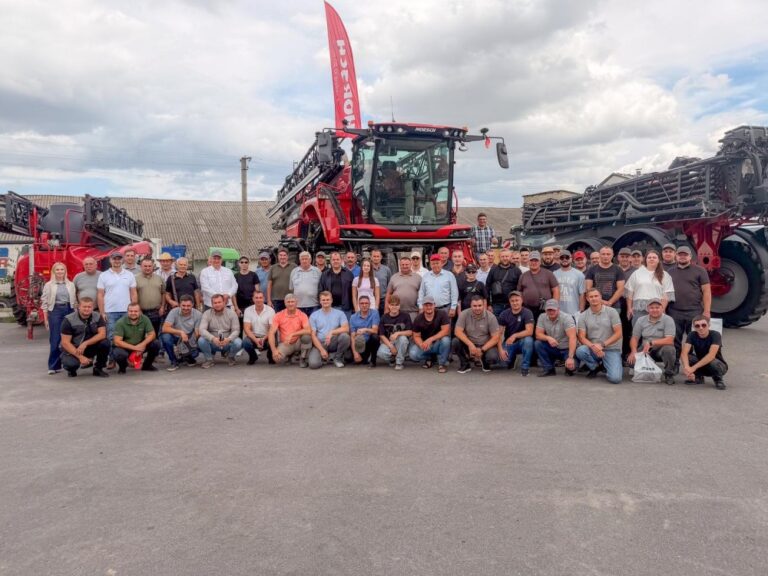
The Hydro Tour team with Viktor Voznyak
And whether irrigation is needed in Zaporizhzhia region, we’ll find out in the next installment of the Hydro Tour project.