An ultra-compact telehandler

«The new arrival meets every requirement farmers have for materials handling. Access to the engine components has been made easier, allowing for faster repairs. It’s worth noting that, thanks to its specifications and innovative systems, the MLT 420 telehandler won Spain’s Movicarga Awards», –
said Camille Rouvre,
Manitou Group product manager.
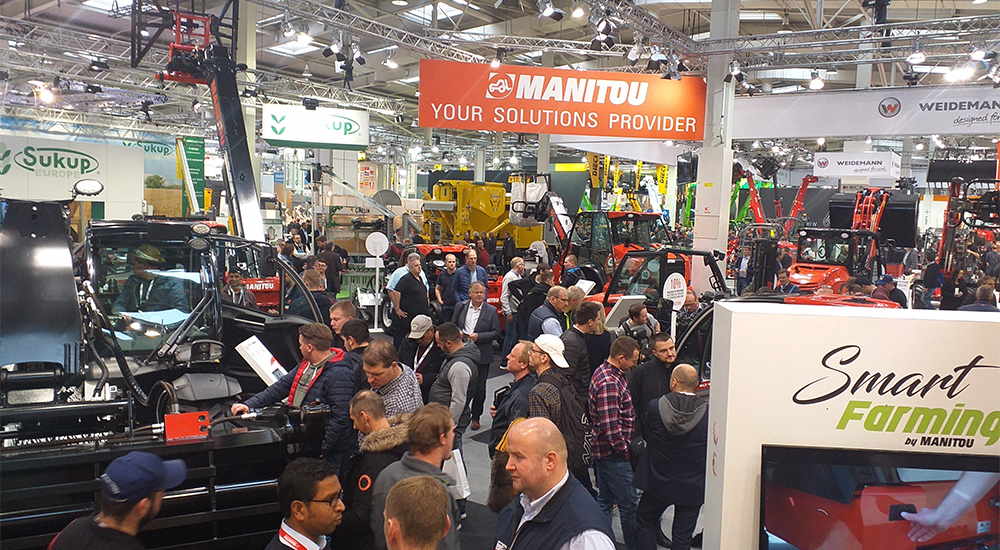
Manitou Group showed off this year’s new arrival at the exhibition – the compact MLT 420-60 H telehandler, fitted with a 57 hp Kubota Stage V engine. For now, only for the European market. It has the smallest dimensions in its class: the machine’s height is 1.97 m, its width – 1.49 m. At the same time it can lift loads of up to 2 t to a height of up to 4.3 m. Four steering modes and a small turning radius (3.06 m) let the loader easily maneuver in confined spaces: farmyards and warehouses. Thanks to full-time four-wheel drive, mudguards and the automatic radiator-cleaning system, the MLT 420 is excellently suited for work in hard-to-navigate, dusty locations. It’s a good helper on the farm for tasks such as loading and unloading bales, cleaning stalls, distributing feed to livestock and so on. The machine arrived in Europe and North America this past summer.
New engine and mast for MC-series loaders
MC-series loaders got new engines that meet the Stage V environmental standard. The MC 18-2 model, presented at the exhibition, is now fitted with a 27 kW engine, while the MC 25 and MC 35 models get 36 kW. As of today, eight Manitou equipment models are fitted with the new units.
What’s more, for MC-series machines with a lift capacity of up to 3.6 t, Manitou Group has designed and started producing, at its main plant in France (Ancenis), a mast with visibility increased by 35–45% depending on the model. The company is now the only all-terrain-loader manufacturer that makes its own masts for its machines.


A new lineup of attachments
Event guests got to see Manitou’s new lineup of multifunctional buckets with a grapple, developed on the basis of the bestselling CBG 2450/1700 model. For better load retention and a longer service life, the bucket’s corners have been changed, and removable teeth added along its sides. The attachment is designed for intensive use and has cylinder protection. The dump angle is more than 90°, letting you work, for example, right up against a wall.
The new BG 1500/850 grapple-bucket model, with a volume of 850 l and a width of 1.5 m, was specially designed for the MLT 420 loader and made using machine welding.
The exhibition’s preview also featured two silage buckets, for work with grain crops, hay, as well as loading and unloading manure. Their volume is 1,200 l and 1,400 l, width – 2.1 m and 2.45 m respectively. The BG model with forged teeth, 2100/1200, is designed for the MLT 630 and MLT 730 machines. The BG 2450/1400 is adapted for other Manitou agricultural loaders.
Remote monitoring system as standard equipment
Manitou Group has included the Connect remote-monitoring system as standard equipment on all Manitou- and Gehl-brand machines ordered in Europe from January 2019. The data collected through it lets farmers optimize equipment operating and repair costs.
«Using the Connect system fitted on the machines, a farmer can analyze the data obtained and lower the total cost of owning the equipment. We studied the performance of 350 MLT 741-140 V + NewAg loaders fitted with the Connect function. It turned out that average fuel consumption across all four actions (loading, unloading, moving and idling) is just 5.78 l/hour. Compared with average market figures, the savings in the machine’s total cost of ownership (TCO) over three years of use comes to more than €4,660», – shares Olivier Le Pesqueur, TCO lead in Manitou Group’s services department.
When choosing agricultural equipment, farmers are increasingly paying attention to the machines’ life-cycle cost. In this connection, Europe has for the first time adopted a single method for measuring fuel consumption in telehandlers. Under the EN 16796-4 standard, which took effect in March 2019, the method for measuring “telehandler” fuel consumption must go through four test phases, such as running at maximum speed (unloaded), loading/unloading, moving a pallet (specific load), and idling.
«For five years now we’ve been measuring fuel consumption in Manitou telehandlers using the REDUCE program calculator on our website. It lets you compare the fuel consumption of two machines depending on the type of operation. Now all manufacturers will report fuel-consumption data using a single calculation method. This way, before making their choice, the user will be able to rely on transparent data. That matters, because fuel costs account for more than 25% of the equipment’s total cost of ownership», says Aude Brezac, head of Manitou Group’s CSR department.

The new High View camera system
The exhibition saw the demonstration of the new High View camera system, developed by Manitou Group to increase precision when carrying out lifting work at height. An additional camera, mounted on the boom and protected by a metal frame, automatically transmits an image to the cab screen every time the boom reaches a certain angle. Thanks to the High View function, loading happens faster, since the operator can monitor the trailer’s fill level without another person’s help. The new camera system is fitted on machines in the MLT Silent Force lineup (MLT 840/1040) and MLT NewAg. High View is also compatible with the MLT 630 V & VC / MLT 730 V & VCP / MLT 635/741/940 V+ and MLT 961 V+ models in the Stage V version.
What’s more, the loader can be fitted with two cameras (side and rear) for more convenient and safer movement.

Automatic Greasing System (AGS)
To simplify maintenance of its telehandlers, Manitou Group has developed an automatic system for greasing important structural elements: cylinders, the boom, axles and so on. It’s fitted with a low-grease-level and empty-reservoir sensor, as well as a pressure-relief valve. Loaders can be fitted with the new system. Unlike other similar products, AGS has three separate lubrication cycles and lets you program the amount of lubricant delivered in each of them. This way, the required amount of grease is applied to the right spot at the right time.
Serhiy Drozd,
product manager
+38 (050) 324-97-76
s.drozd@astra-group.com.ua