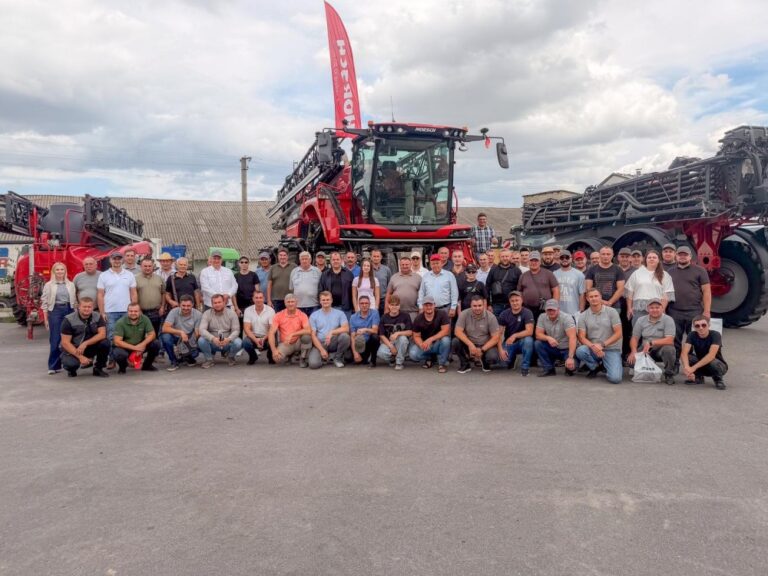
During the “Spring 2016: Key Challenges and How to Solve Them” conference, organised by Astra Agricultural Construction Alliance, a Latifundist.com journalist spoke with Attila Naradi, owner of the Hungarian plant “FraMest”, which has been cooperating with agricultural machinery dealer “Astra” for 10 years now and supplies Hungarian soil-cultivation equipment to the Ukrainian market. The foreign specialist’s view on the features of the Ukrainian agricultural sector turned out to be very interesting.
Latifundist.com: Mr Naradi, please tell us a little about the history of your plant. How did “FraMest“ enter the Ukrainian market?
Attila Naradi: My friend and I founded our company 15 years ago. At first we made frames for import companies. But after three years we decided to develop our own machinery, first and foremost with farmers’ needs in mind. And our machinery was a great success on the Hungarian market. That’s when we met the owners of “Astra”, who had already been able to watch our machinery succeed in Hungary. And they decided it could be introduced in Ukraine as well, since Hungary’s and Ukraine’s climatic conditions are quite similar.
Latifundist.com: What was the hardest part, and how did you achieve success in your business?
Attila Naradi: The biggest problem in our work was getting farmers to understand that this isn’t just machinery. That is, the farmer needs to understand that he isn’t just buying “iron”, but a new opportunity. That’s very hard to explain to agricultural producers. And to this day, a third of our customers in Hungary still buy “iron” from us. We don’t understand why a farmer wouldn’t want to use the machinery to its full potential. So part of my job, part of my mission, is to pass on to people all the knowledge and experience I’ve accumulated during my research. It’s important to me to show them that everything can be done better and to a higher standard. Everything else – financing, investment, human resources – is all solvable.
Latifundist.com: And what about the Ukrainian market? What difficulties came up when you first arrived here?
Attila Naradi: Since we’re a young, small company, a huge problem was that nobody knew our brand. Farmers had no idea who we were or what we produced. That caused a certain distrust among producers. It was “Astra” that helped us build that trust, ran quite a few presentations for farmers, and that’s when the market learned about our products.
Latifundist.com: What features or specifics does the Ukrainian market have?
Attila Naradi: The Ukrainian market is unique in that it hides an incredible number of opportunities, in the sense that people could produce far better and higher-quality output. And with our machinery we can help push the current yield level upward. Ukraine is a country of opportunity, where you can grow in any direction. But you know what other problem there is with Ukrainian farmers?
Latifundist.com: What is it?
Attila Naradi: They say “NO” to everything far too often. And farmers don’t even stop to think that this hurts their work. You need to be a little open to new things and not be afraid of them. I sense this fear in many farmers – the fear of experimenting with new technologies.
Latifundist.com: And who is it easier for you to work with in Ukraine: medium and small enterprises, or agroholdings?
Attila Naradi: I like working more with medium and small farmers, because I can look the owner in the eye, work directly with the person who understands every problem that comes up and makes decisions “in the field”. Whereas at a large company I might talk to 10 specialists, but not know whether that information will reach the company’s leadership, or whether the result will be positive. Holdings are harder to work with, but we do have good partners among them too, effective partners who are fairly open to change.
Latifundist.com: And who was your first customer in Ukraine? How did the cooperation begin?
Attila Naradi: Oh, that was a very long time ago. I remember his name was Viktor Mykolaiovych. The cooperation moved forward with great difficulty. It was hard to sell him our machinery. He knew everything better than us, he taught us how things are done, even tried to convince me that my machinery was bad and didn’t work (laughs).
And there was a case when one of the shafts on the cultivator broke. Because of that shaft I had to come to Ukraine myself, so to speak “on the carpet” in front of the farmer, where I had to listen to how terrible our machinery was. By that time we’d already fixed everything, and at the end he patted me on the shoulder and said his sugar beet yield had gone up by 15% and that this machinery really is good. That’s a very meaningful memory for me, one I’ll never forget.
The conclusion we draw from all this is: you need to explain in great detail what we want to build on the market, that you must always pay attention to both customers and partners, not only before the sale but after it too. You need to think about them and care about them, visit them, look at how the machinery is performing. Then you can see a lot, analyse the results of the machinery’s work and the options for improving the technology.

Latifundist.com: What is the company’s further development strategy on the Ukrainian market?
Attila Naradi: As you already know, we’ve been working with “Astra” for 10 years. After 10 years, we want to shift our strategy a little – namely, our company’s main goal should be working with farmers. I’d like to get across to farmers not simply that we have good machinery, but also the fact that there is a culture of soil cultivation, that it’s very important for preserving the fertility of black soil, increasing yield and, accordingly, profit. To get across the fact that our machinery conserves quite a significant amount of moisture, and thereby reduces costs. But words alone aren’t enough for that. You also need to show the machinery at work, in field conditions and, naturally, gather the results and show what the soil was like before cultivation and what happened afterward.
Latifundist.com: And what was the first machine you brought into Ukraine?
Attila Naradi: The first machinery brought into Ukraine was the “FraKombs”. They became popular quite quickly, because they gave producers a significant increase in yield and a reduction in soil-cultivation costs.
Latifundist.com: What machinery do Ukrainian customers buy most often?
Attila Naradi: Let’s start with the fact that the buyers are those who have difficulty working the soil, those with heavier, dry, clayey soil. Where the black soil is good, almost any machinery can work with no trouble. Because there are fewer problems there, and the mistakes a farmer makes won’t lead to disastrous consequences.
Latifundist.com: At the start of our conversation, you said that almost no farmers – Hungarian or ours alike – have a culture of soil cultivation. What does a proper culture of soil cultivation mean?
Attila Naradi: Water is a strategic product for the next 50 years, and one of the most important components for achieving a high yield. 10% of the future harvest depends specifically on this component. What’s more, I recently found a book from 1917, and its very first line reads: “The main reason for a farmer’s poor harvest is poor soil cultivation”. We manufacture soil-cultivation machinery, and when we visited many farms and gathered a great deal of information, we set ourselves a goal – to create machinery that would preserve as much moisture in the soil as possible. Because it’s very important that the rain that falls reaches and is retained in the right layer of soil.

Most farmers don’t look beneath the surface of their field. For some reason that doesn’t interest them, all that matters is what’s on top. But that’s wrong. Because it’s important to understand what the seedbed will be like, and in most cases it turns out to be compacted and dry. The question is: are we really going to sow grain into soil like that? The seedbed should be even, crumbled and properly compacted. I travel a lot through Hungary and Ukraine, often just pulling over at fields, taking photos, checking the soil. And here’s what I’ve noticed. In most cases, if you cut a soil profile 1.5 metres deep, you can clearly see that the fertile layer reaches a maximum of 30 cm. Deeper than that the soil is dry and compacted, often with signs of erosion, from repeated ploughing with an improperly adjusted implement.
Latifundist.com: And how do you teach farmers this culture?
Attila Naradi: You know, even people far more prominent than me haven’t managed to do that. But this will manage it (ed. note: Mr Naradi took a coin out of his pocket and showed it to us). When people risk their own funds, their own money, then after a certain amount of time, they start counting. And when that happens, farmers see that not everything is going smoothly. And only once they reach that realisation does interest appear. They come to presentations, to conferences, to learn more.
I know companies in Ukraine that are fully familiar with American, English and German technology, that have travelled the whole world in order to take on board everything best for their own farming. But that’s not enough. Ukrainian agricultural producers need to be more curious, need to learn a great many things, and most importantly – test various technologies on small plots. Because when it comes to soil cultivation, there’s no limit to what you can learn – you need to constantly improve, pay attention to details, keep learning.
I believe Ukrainian farmers are capable of this. They can learn a culture of soil cultivation, and achieve higher yields for their crops. And if we, as machinery manufacturers, can help them with that, I’ll be very proud to have taken part in that process. I always say there are no miracles! There are wonderful people, who, given the will and the learning, can achieve the impossible.
Latifundist.com: Thank you for this interesting conversation!