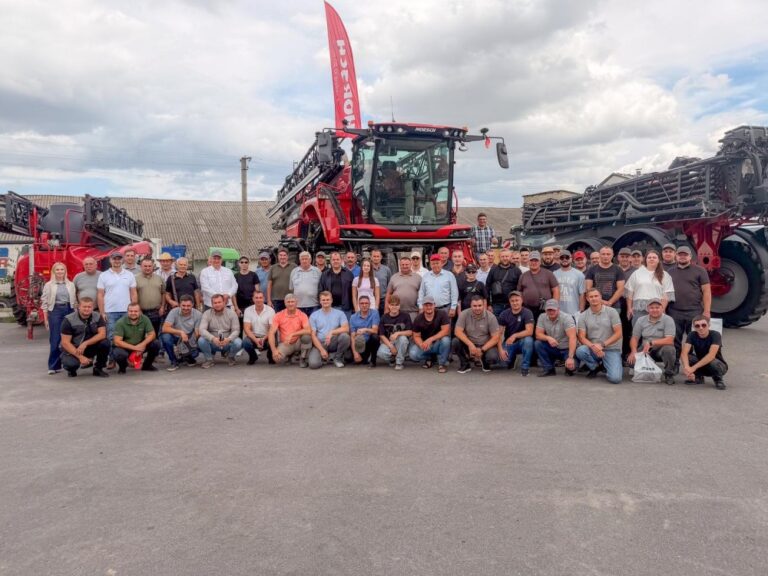
Juliette Efendieva, head of the precision-agriculture department at Al Dahra Holding
Think growing wheat in a zone of risky farming is hard? How about the challenge with a real twist — getting a harvest on the sands of North Africa? That’s exactly how Al Dahra Holding’s African project began — an international company from the UAE, headquartered in Abu Dhabi. This agroholding’s land, across various countries, covers roughly 150,000 ha in total.
In an exclusive interview with Al Dahra Holding’s head of precision agriculture, Juliette Efendieva, during the Cropio Camp 2018 intensive training, Latifundist.com managed to “dig into” the history of desert farming and learn about the Arab investor’s plans for the Black Sea region.
Latifundist.com: Juliette, we were told you’re a specialist with unique experience preparing African sand lands for growing wheat on them. Where did you work before this?
Juliette Efendieva: At the Russian company “Agroinvest”, as a dispatcher in the precision-agriculture department. My first project was called Toshka. It was named after a local lake. As part of it, I implemented an irrigation system in the fields.
Latifundist.com: Tell us, how did Al Dahra Holding’s wheat project in Africa begin?
Juliette Efendieva: There used to be desert where our fields are now. There we had to build literally everything from scratch, starting with the road. Thanks to the irrigation canal nearby, we ran an irrigation system to every field. And we save a great deal in the process. For example, the company installed solar panels in the region where we operate, and everything runs on that energy.

The irrigation canal
Latifundist.com: So the soil there is entirely sandy?
Juliette Efendieva: Yes, sandy.
Latifundist.com: Is it possible to grow wheat and other crops under these conditions?
Juliette Efendieva: Yes. But our project is young, so for now we only grow alfalfa. Though you can cultivate anything, if you apply the technology used in Egypt on sandy soil. So, alfalfa needs to be planted on the field for five years — over that time it prepares the soil. Then you can even sow wheat. Maybe in three years we’ll be growing something else, but there’s a chance alfalfa will remain our main crop
.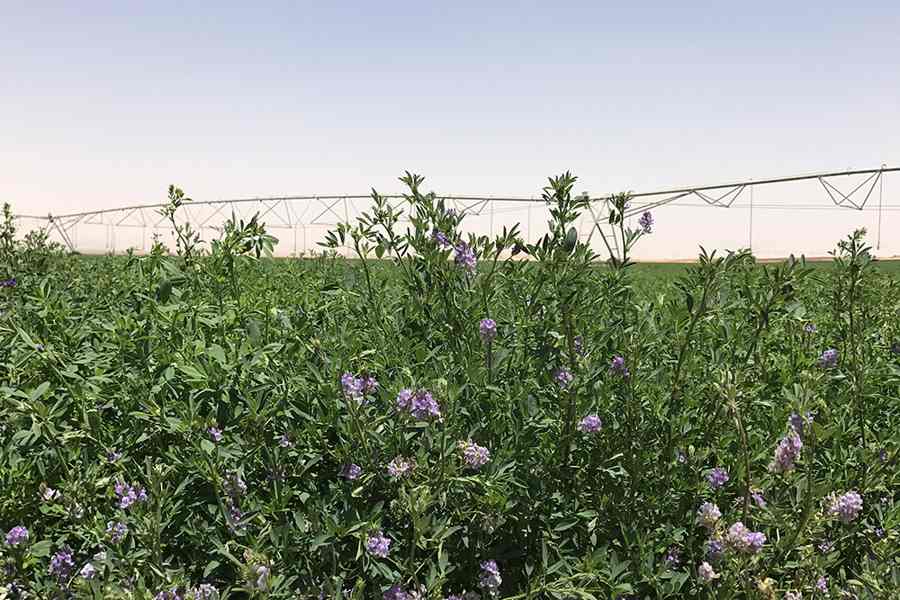
Alfalfa
Latifundist.com: What do you use the alfalfa for?
Juliette Efendieva: Alfalfa is good feed for livestock, so we export the product we grow. We pack it into bales and send it for sale to the United Arab Emirates, and some is sold in Egypt. One of our largest contracts is with the company Adafk. What’s more, part of the alfalfa is bought by our office in Egypt.

Alfalfa prepared for sale
Also read: A climate blow: salvation lies in irrigation
Juliette Efendieva: We’ve been running this program for 2 years now. The area covered — 8,000 ha, on which 177 Valley irrigation units are installed. We have three farms. On one we grow alfalfa, on the second oranges, and on the third — alfalfa, wheat and potatoes.

A Valley irrigation unit
Latifundist.com: Just to confirm, this is one of three Al Dahra Holding enterprises in Egypt?
Juliette Efendieva: Yes. The second enterprise, located in Egypt, farms 5,500 ha, and the farm near the city of Salhiya — around 2,500 ha.
Latifundist.com: And on which other continents does Al Dahra Holding have land?
Juliette Efendieva: It’s a fairly large company. It owns land in Europe: Greece, Italy, Spain, Serbia, Romania. There are plans to buy land in the Black Sea region. There are also agricultural assets in the UAE, India, Pakistan, Vietnam, Australia, Brazil, the US, North (Algeria, Morocco, Egypt, Sudan) and South Africa.
Latifundist.com: Where’s the head office located?
Juliette Efendieva: The head office is in the Emirates, in Abu Dhabi. Rice-processing factories are also located there.

Al Dahra Holding’s office
Latifundist.com: Do you have an international team?
Juliette Efendieva: Yes, a lot of Egyptians, South Africans, English. Management at our main office in Cairo is represented by Egyptians, but at each farm, the general directors are essentially English or South African.
Latifundist.com: Let’s go back to the farmland. Is it all located around the Nile?
Juliette Efendieva: Yes, all the farming is concentrated around the Nile, people settle exactly there, because you simply can’t survive in the desert. Our farm is near a fairly large lake, Lake Nasser, which is where the irrigation water comes from.
Latifundist.com: What’s the specific nature of your work? You work with irrigation, right?
Juliette Efendieva: I personally head the precision-agriculture division. As part of this work, I originally implemented the Cropio satellite crop-monitoring system at our enterprises. It’s already successfully running at all three of our farms. Though not all the modules are fully operational yet.
The Cropio satellite crop-monitoring system
For example, telematics is already connected, but no tasks are being created yet. In the future we plan to integrate our farms in other countries into the system too, since there’s a lot of land and it needs to be monitored effectively. What’s more, I oversee the company’s irrigation system.
Latifundist.com: Are your units pivot-type?
Juliette Efendieva: We use Valley pivot units and the BaseStation system — Pivot control. Originally the entire irrigation procedure took much more time and required high costs. You had to get in the vehicle, drive out, switch on the Pivot, set the controls. Now, just one button press is enough. What’s more, before, any breaches or flooding could only be recorded visually (driving past). Thanks to the new unit, we get all the information on the spot. If an emergency happens, the Pivot stops, and a notification about the incident comes in. Another plus of this system is that we can also control the water flow.

The irrigation system
Latifundist.com: Does the money invested in the infrastructure pay for itself? Wouldn’t it be simpler to farm, say, in Ukraine?
Juliette Efendieva: Toshka is a young project, we’re still investing a great deal into it, not everything’s built yet. But we’re already approaching the final stage. As an example, there’s a farm that’s been operating longer than us and is exceeding its plan by 40%. Yes, we’re still coming out at “zero” for now, but other farms really are earning money. Maybe that’s also partly because prices in Egypt are quite low.
Latifundist.com: Egypt — is an import-dependent country, but today Africa as a whole has taken up, not quite import substitution, but has started thinking about ramping up production. Isn’t that so?
Juliette Efendieva: Today, in our negotiations, we emphasize that Africa needs to take up agriculture and its own production. Our project envisions cooperation between the UAE and Egypt, which benefits both countries.
Latifundist.com: It’s interesting to learn about the specifics of the African market. What experience have you gained over two years of work? What are the particulars of doing business there? There’s a stereotype that Ukrainians don’t want to work with Africans, fearing they’ll be cheated.
Juliette Efendieva: That’s a myth. But one thing is for sure — things are different in the Middle East, people there are different: a bit more relaxed, you need to push them along, otherwise it’ll be difficult. That applies to both Egypt and the UAE.

Juliette Efendieva
Latifundist.com: So if you agree to meet at 12, you might as well not expect them on time?
Juliette Efendieva: If, say, you agree to meet at 8, it definitely won’t be earlier than 8:10. Though it’s not like everything’s difficult there. I used to think they were all a bit lazy too, but no, there are very smart and motivated people. It probably depends on the person.
Latifundist.com: Back in the day, medieval England resisted the creation of the first sewing machine out of fear of losing jobs. In the end, the queen rejected the project. Egypt is also considered a conservative country. The question arises about precision agriculture and strict land monitoring — doesn’t it cause pushback locally?
Juliette Efendieva: Yes, yes, I know about that historical fact. But monitoring work isn’t about wanting to catch someone making mistakes. On the contrary, we want to identify mistakes, fix them, and make the work more productive.
In Egypt there was no resistance to this system, management decided from the start to work this way. The farmers were also all “for” it, they actively use new technologies in their work. We gave examples and told them how many hectares our drivers process on the same equipment. But they didn’t believe us, they said it was impossible. Until we showed concrete examples. If you compare figures for August 2016 and February 2018, equipment productivity is up 70%, and working time increased by 40%.
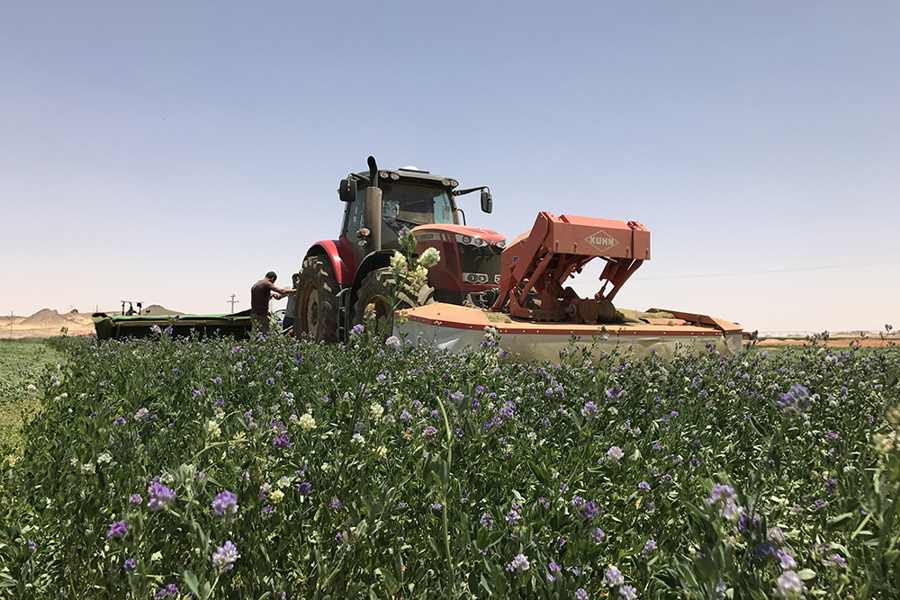
The enterprise’s equipment
Latifundist.com: In Ukraine there are a number of companies that make systems to prevent fuel siphoning and break-ins. Do you use similar protective measures? Or is there no theft here?
Juliette Efendieva: We don’t use them, but we plan to implement that in the future, since it’s important. Though it’s not like theft cases are widespread in Egypt. Take, for instance, that same diesel fuel. If in Russia you could easily sell it to a neighboring farm, here it’s open space, everyone’s in plain sight of each other. Essentially, we’re isolated. There’s just desert all around, the nearest village is 50 km away. That’s where we buy food. We live on the project site, in specially built houses. I’ve already gotten used to it, since it’s very interesting here.
Latifundist.com: Thank you for the tour of African agricultural realities.