In this article, Michael Horsch explains which seeding method is optimal under which conditions, how it can be applied, and what prior tillage it requires. He focuses primarily on disc and tine seeders.
Where and which machinery is better to use?
«Over the past years we’ve built up a very large body of experience using tine machines for direct seeding», sums up Michael Horsch. The Airseeder machine, and later the Sprinter model range with various working tools, have been continuously refined and improved over the years. Today they provide a wide range of capabilities: from direct seeding with minimal soil disturbance to nearly full-coverage tillage.

In particular, tine coulters are used in regions where seeding takes place straight into stubble right after harvest. This applies to seeding rapeseed or cover crops. Such coulters clear the seed furrow well and create the conditions for good seed-to-soil contact.
Another significant advantage in colder regions is somewhat faster soil warming. «For example, in Kazakhstan (where narrow tine coulters and seeding into an open furrow tend to prevail), the Sprinter NT is used with great success. The tines clear the furrow and leave an almost black surface behind them in the row. As a result, the soil warms quickly and ensures rapid germination of plants in a cold spring», — shares Michael Horsch from his own experience.

Using disc and tine seeders as examples, Michael Horsch explains which direct-seeding method suits which conditions, where it’s common, and what prior tillage it needs
«Over the past 10 years we’ve also worked intensively on disc seeders for direct seeding». This kind of machinery is in high demand in regions with either excess moisture or, conversely, very dry conditions. That’s because disc seeders move far less soil than tine machines. For example, in Brazil our clients seed into a layer of the preceding crop’s straw or into a cover-crop plant canopy. When a lot of bare soil is left after the machine passes, the risk of erosion rises sharply, and without a plant cover, soil temperature increases substantially. The HORSCH SingleDisc coulter is agronomically optimized for the least possible disturbance to soil structure and precise seed placement. «The coulter on our Avatar seeding complex makes a narrow cut in the soil surface and places seeds very precisely on the bottom of that furrow. Adjustable press wheels reliably close the furrow».
Straw: both a benefit and a challenge at once
«Crop residue from the preceding crop, or a well-developed cover crop, creates both opportunities and additional challenges at the same time». Straw serves as a source of nutrients and organic matter, and in this way is an important factor in building and maintaining humus levels. Residue on the field surface protects the soil from erosion and helps cool it. «If we can build up a mulch layer of straw between the rows of the new crop, then under dry, hot conditions it will prevent the soil from heating up further». A straw layer acts as a kind of soil insulation. The air pocket within the straw mulch creates a barrier against heat reaching the soil surface. What’s more, especially light-colored straw, wheat straw for example, additionally reflects solar radiation, reducing soil heating. This effect can be especially relevant for regions with high temperatures and dark soils.
Seeding into wheat stubble with disc seeders
Stubble and straw cover differ substantially. A lot depends on the crop type and, accordingly, on the amount of straw left after harvest, as well as, of course, the properties of that crop residue. «A significant challenge is seeding into a white (that is, fresh) layer of wheat, barley, or rye straw. Right after harvest the straw is still very tough and hard to cut. If you seed with disc machines under these conditions, there’s a significant risk they’ll press the straw down into the bottom of the furrow. This negatively affects row closure and subsequent emergence. In this case there’s a good solution – row cleaners. But they can only be fitted to machines with 25 cm row spacing».
It’s much easier to direct-seed into brittle, crumbly straw. «If sunny weather with periodic rain holds for four to five weeks after harvest, straw (wheat, for example) becomes much easier for the discs to cut. Then the risk of straw being dragged into the furrow drops noticeably».
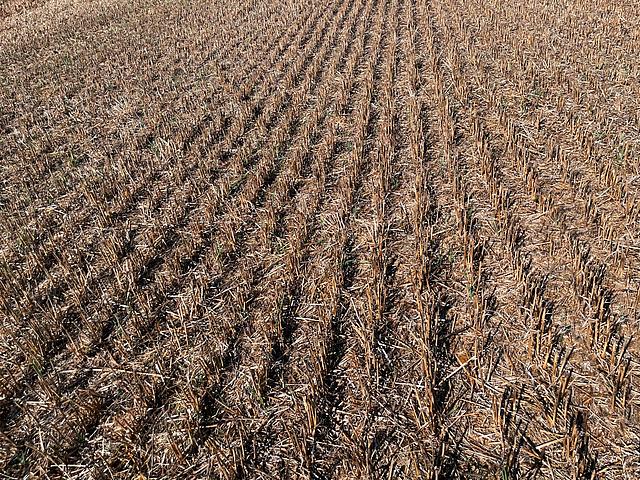
Fresh straw right after harvest is very often fibrous and hard for working tools to cut. As a result, a lot of straw ends up inside the seed furrow
If you have to seed right after the combine’s pass, it’s worth first lightly chopping the crop residue. The Cultro unit with a spring-tine harrow, which chops and distributes crop residue, is well suited for this. As a result, the discs cut the soil more easily and drag less straw into the furrow. «This kind of shallow tillage is especially useful under dry conditions, when there’s a lot of dust in the field. Even if it’s just 1–2 cm, that’s enough to close the capillaries. That’s fundamentally important. If you “break” the soil surface and close the dry cracks, residual moisture will rise into the upper dust layer. This way you can also moisten the soil and then seed – you have a chance of getting good emergence».
Let’s sum up the topic of soil cracks once more: once they’ve formed on the field surface, the stronger and longer the drought, the bigger and deeper they’ll be. For the soil, cracks act like a chimney: all the moisture rises and evaporates through them. Naturally, this significantly complicates seeding and subsequent seed germination. «On heavy clay soils, on the other hand, a different problem arises: the ground becomes concrete-like, and the longer the sun shines, the harder it gets». Under these conditions, you need to close the cracks as early as possible. As experience from the last two years shows, the ideal implement for this is the Cultro TC, which works at high speed with minimal input.
Seeding into fresh wheat stubble with tine seeders
When there’s a layer of fresh straw in the field, an alternative is to seed with tine seeders. This practice is common in France. «For seeding cover crops, and sometimes rapeseed too, farmers there choose Sprinter machines with narrow tines. Narrow tine coulters easily clear straw out of the seed furrow».
When sowing cover crops, soil structure isn’t quite as critical: «This isn’t about absolute perfection». But if you need to seed a main crop, rapeseed for example, into overly dry soil, soil structure becomes the priority, even when straw management is fully under control. «If, during harvest, machinery passed over the field many times, direct seeding can still be done. But then you shouldn’t be surprised that seed germinates worse in the wheel tracks, and the root system develops poorly. Then, at threshing time, it’ll be especially clear where the tracks were – because in those spots the stand is thinner and the yield lower».
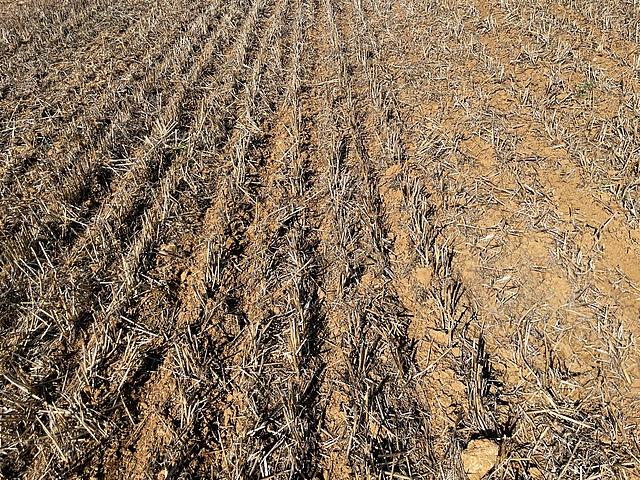
Seeding into a large amount of straw with disc seeders is quite difficult.
Row cleaners can help
The more practical experience you have, the better you understand what good, correct soil structure looks like. When soil clods are loose and have small pores, even dried-out soil is able to absorb moisture and swell. But if the clods have smooth, sharp edges with no pores, that shows the soil is over-compacted. «In that case, there’s not much to expect, even if it rains. In fact, quite the opposite — things get worse. That’s why, in regions where zero-tillage is common, cover crops play a fairly significant role, helping ensure optimal soil structure».
We already mentioned in a previous article that for cereals, stubble height and straw distribution matter. Mice can be a serious problem here. Michael Horsch considers this pest one of the biggest problems for direct seeding in Central Europe.
Rotational direct seeding — why this alternative approach is becoming more widespread in Central and Western Europe
Rotational direct seeding is increasingly becoming an alternative approach. The driver of rotational direct seeding is the right conditions and soil structure, as well as the state of crop residue and the preceding crop. Direct seeding can likewise be optimal and deliver a high yield, even when carried out after intensive tillage.
«By rotational direct seeding, we mean alternating use of zero-tillage — in years with optimal conditions, and depending on the crop type». Three important factors support this approach (particularly in Europe).
- Not every crop rotation suits zero-tillage. In past years, a rotation of rapeseed – wheat – barley, or rapeseed – wheat – wheat, was common. With this rotation, direct-seeding the next crop often didn’t produce a high yield. «For many years we all successfully used this kind of short crop rotation with great success. But now, in many regions, crop rotation has been widened again, influenced by many different factors — resistance, general farming conditions, and so on». If the rotation consists of 30–40% spring crops, such as corn, soybeans, sugar beet, or sunflower, there’s an opportunity to include cover crops in the rotation. Or if the next crop simply needs to be seeded using zero-tillage. «We’ve very often seen how our clients, having a good cover crop, direct-seeded sugar beet into soil with an excellent structure, without any prior tillage at all. In that case, there’s no point at all in preparing a seedbed, needlessly compacting the field with another machinery pass».
- The second reason for the spread of direct seeding is climate change, whose effects we’re noticing more and more. «We see that droughts are becoming longer and hotter. But in August/September certain crops still need to be seeded, in particular rapeseed, cover crops, or early wheat or rye varieties. Any tillage causes additional soil drying, worse moisture retention, more clods, and less fine structure, and so on. In these situations it’s better to leave a straw layer on the surface, closing cracks and pores. For this, it’s worth running an implement like, for example, the Cultro TC, and seeding the seed in good time into soil with residual moisture. That is, seed when soil structure and straw management are optimal. Then you can place the seed well, and tillage isn’t necessarily required. Fundamentally it works like this: «On fields with a lot of crop residue, it’s more prudent to apply direct-seeding technology than where there’s little residue, for example after soybeans, rapeseed, sunflower, or peas».
- When soil structure is very good and the field is clean after the combine’s pass, with a broad crop rotation, or a time window for the straw to partially decompose, rotational direct seeding is also attractive from a financial standpoint. Fewer machinery passes means saving time, fuel, and machine depreciation. Combined with excellent seeding quality, this can be a decisive factor in favor of direct seeding, first and foremost from an economic perspective.
«The topic of crop residue, that is straw, runs like a common thread through the whole of direct-seeding technology», — sums up Michael Horsch. First and foremost, this concerns large amounts of cereal residue, mainly wheat, as well as barley and rye. Rye is the least problematic, even with a large amount of straw, compared to barley or wheat, which is always the most difficult. The reason lies not so much in the amount of straw as in its C/N ratio, and accordingly, its ability to decompose.
ABA “Astra” Agro-Building Alliance is one of the largest suppliers and service operators of agricultural machinery in Ukraine. The company’s core activities are the sale of new and used agricultural machinery, warranty service, and the sale of spare parts.
“Astra” offers its clients a wide range of machinery for practically every type of agricultural work: Fendt, Valtra, Manitou, Berthoud and Horsch, Framest, Bogballe, Valley, Trimble, Oros. The company supplies customers with the widest range of genuine spare parts to support all models of agricultural machinery from world-renowned manufacturers. Servicing agricultural machinery holds a key place in the company’s operations, covering nearly the entire territory of Ukraine and ensuring a fast response to farmers’ requests.
“Astra” has been operating on Ukraine’s agricultural market for 25 years, providing agricultural producers with quality machinery, innovative agricultural technologies, and a consistently high level of service