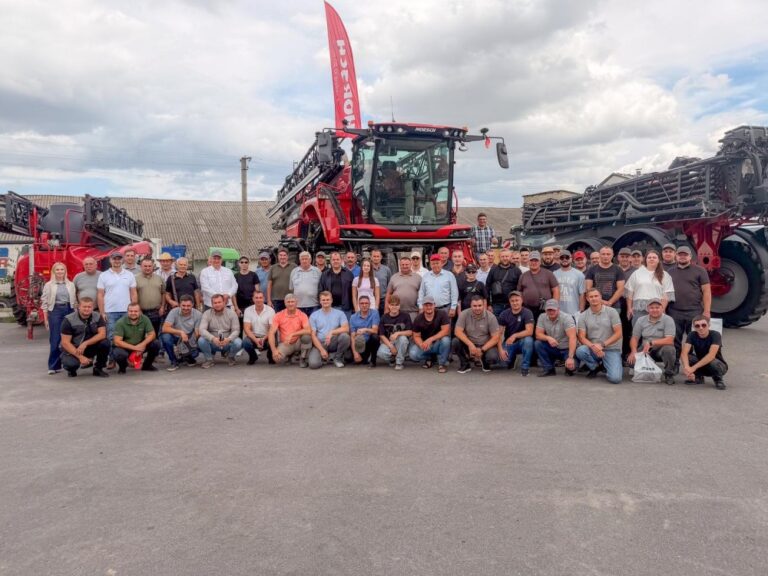
DLG observes the test and confirms its results
In early August 2020, Fendt ran output trials for the large-frame Fendt IDEAL 9T combine harvester. As independent observers, the trials were accompanied by experts from DLG TestService GmbH. During the trials, the Fendt IDEAL 9T was compared with another combine in the same power class, and stood out with good results for output and grain loss, as well as grain quality and straw length.

The trials were accompanied and documented by the German Agricultural Society’s testing service centre (DLG TestService) as an independent body. Engineers at the DLG TestService testing centre in Gross-Umstadt have been running combine harvester trials for many decades now. External expert support was provided by Thomas Rademacher, professor of agricultural engineering at the Bingen University of Technology.
“The goal of this series of trials is to build what’s known as a performance-loss characteristic curve for various combine harvesters,” says Prof. Thomas Rademacher. “For this, the machines harvest a field at different output levels and travel speeds. At the same time, grain loss is measured and its quality determined.”

The graphs show a trend curve, mathematically calculated based on the measured figures. A broken-grain share of 0.8% is the average of all measured figures.
High output at low loss levels
The trial series was run in early August during wheat harvesting, at speeds from 4 to 8 km/h. The Fendt IDEAL 9T operated at a maximum speed of 8 km/h and reached a total output of nearly 150 tonnes and a grain output of nearly 89 tonnes per hour. In the trial series, the comparison machine showed lower maximum output and a significantly higher loss level. At a grain loss of 1%, the Fendt IDEAL 9T’s total output was 21.5% higher.

The graphs show a trend curve, mathematically calculated based on the measured figures. A broken-grain share of 0.8% is the average of all measured figures.
Fendt IDEAL with almost no broken grain
Foreign matter and broken-grain share play a decisive role in determining harvest quality. In particular, at low grain-moisture levels, intensive threshing-system settings can quickly increase the broken-grain share. At grain-moisture levels of 12 to 13%, the Fendt IDEAL 9T had the best figures, with a very low broken-grain share – from 0.1 to 0.3%, while the comparison machine’s broken-grain share was significantly higher, from 0.8 to 1.5%.


The graphs show a trend curve, mathematically calculated based on the measured figures. A broken-grain share of 0.8% is the average of all measured figures.
A high share of long straw
As part of the trial series, straw quality was also checked. Straw samples were taken from windrows, and a grading curve was then determined using a DLG cascade sieve.
When harvesting in windrow mode, the Fendt IDEAL 9T’s straw quality differed from the comparison machine with higher shares of long straw fractions (> 67 mm and 30 to 67 mm) and smaller shares of fine fractions (

About the combine comparison test
During the trials, the Fendt IDEAL 9T and a combine harvester of the same output class, with a header of the same working width, threshed wheat. Good harvest conditions predominated at the test plot in Mecklenburg-Western Pomerania. The wheat had a grain moisture of 12 to 13% and a straw moisture of around 10%. The grain-to-straw ratio was 1:0.65.
Both machines were calibrated before the trial and set up by technical specialists from the respective combine manufacturer. For this, so-called trial runs were carried out before the actual measurements, to optimally match both combines’ settings to the harvest conditions.
“There are standards that regulate measurement methods. In this trial series, we used what’s known as the belt method. That is, all the combine’s residue lands on belts and is then cleaned again, so the grain loss can be picked out and weighed. In parallel, sample trays were used as an additional control method to assess loss,” says Professor Rademacher.
In the comparison trial, the combine harvesters move “track to track” and always at full capacity, to minimize differences in crop stand and create identical conditions for every machine.
“The evaluation follows the principle: everything that goes into the machine has to be weighed,” says Prof. Thomas Rademacher. “After each measurement, the combine unloads grain into a weighing control wagon, and the harvest quantity is documented. The straw-and-chaff mass collected on the sheets, as well as the grain loss picked out of it, are also weighed. Based on travel speed and the amount of grain and straw, we determine grain throughput, in particular, total output. We calculate grain loss based on the weighed grain from the residue and grain yield.”