For anyone interested in the experience of Ukrainian agricultural producers implementing irrigation systems, this article is a must-read.
When people in Ukraine talk about irrigation, they usually picture the fields of Kherson or Mykolaiv region. This time we visited one of Ukraine’s abnormally dry spots, but outside those geographic zones — a place rain doesn’t reach, even when precipitation falls nearby. The “Lan” agricultural firm is ready to carry out an irrigation investment project with “long” money, not just to increase yield, but also to pay shareholders more. To see what that looks like in person, Latifundist.com headed to Dnipropetrovsk region.
The dry wedge
The village of Novovyazivske sits at the highest point in Dnipropetrovsk region. Over the last ten years, a kind of “dry wedge” has formed here: “Poltava” rains don’t reach it, stopping around the Oril River, “eastern” precipitation — visits extremely rarely. Even when rain “peeks into” neighboring villages, Novovyazivske gets bypassed, as if on purpose.
When the whole country was complaining that rain had disrupted the wheat harvest, the locals silently envied them – here they hadn’t seen rain in a couple of months. Average annual precipitation in the village’s area is around 360 mm.
Local farmer Serhiy Malovyk has worked in agriculture since birth. He started as an operations engineer at the local collective farm, and in the last years of the USSR’s existence managed to work as the collective farm’s chairman. In 2000 he founded the “Lan” agricultural firm; in its best years the company’s land bank reached 10,000 ha. As competition grew and shareholders left to farm independently, that figure shrank to 8,000 ha.
«Under the collective farm there was irrigation here on 1,500 ha. Then it fell into disrepair, the pipes were dug up and stolen. Looking at this weather now, everything’s shifting toward heat — we decided to restore irrigation. You don’t choose your homeland or your parents. Whatever God gave you — that’s where you work, that’s where you live. The guys have in-laws in central Ukraine, it rains there, things just grow on their own. They get a yield of 3.8 t/ha for sunflower, corn — 12 t/ha. But for us, in the best times, it’s 5-6 t/ha for that same corn, and usually 3 t/ha. We applied everything we could to the fields —anhydrous ammonia, all sorts of fertilizers. But there was no rain, everything burned», — laments Serhiy Malovyk.

Serhiy Malovyk, head of the “Lan” agricultural firm
Before setting about “reviving” irrigation, the farmer’s sons Mykola and Serhiy decided to survey the ground and went to study how irrigation works in other regions. The experience of the “Mayak” agricultural firm in Cherkasy region impressed them most. Mykola Malovyk says what they saw inspired them for years to come.
«Oleksiy (Vasylchenko – deputy director of the “Mayak” agricultural firm – ed.) — is great. We saw everything at his place, and understood what and how needs to be done. He has around 2,000 ha under irrigation there, and thanks to that he has cattle, and pigs, and a lot more», — says the farmer’s son and, at the same time, deputy director of the “Lan” enterprise.

Serhiy Malovyk, deputy director of the “Lan” enterprise
After returning, Mykola and Serhiy kept thinking it over. Then they came to their father and suggested taking on irrigation after all. “And he told us, ‘we need it, but we’re not doing it’”, — Mykola smiles.
But the sons still managed to convince their father the investment made sense. At first they planned to launch irrigation on 100 ha, but in the end decided on 500 ha.
The question became — which equipment to choose. Under the Soviet Union, DDA and DDN sprinkler machines worked here. The enterprise decided to switch to new equipment. They looked through many options — both imported and domestic. As a result of the “casting”, they settled on the offer from the “Astra” Agro-Construction Alliance — Valley sprinkler machines.

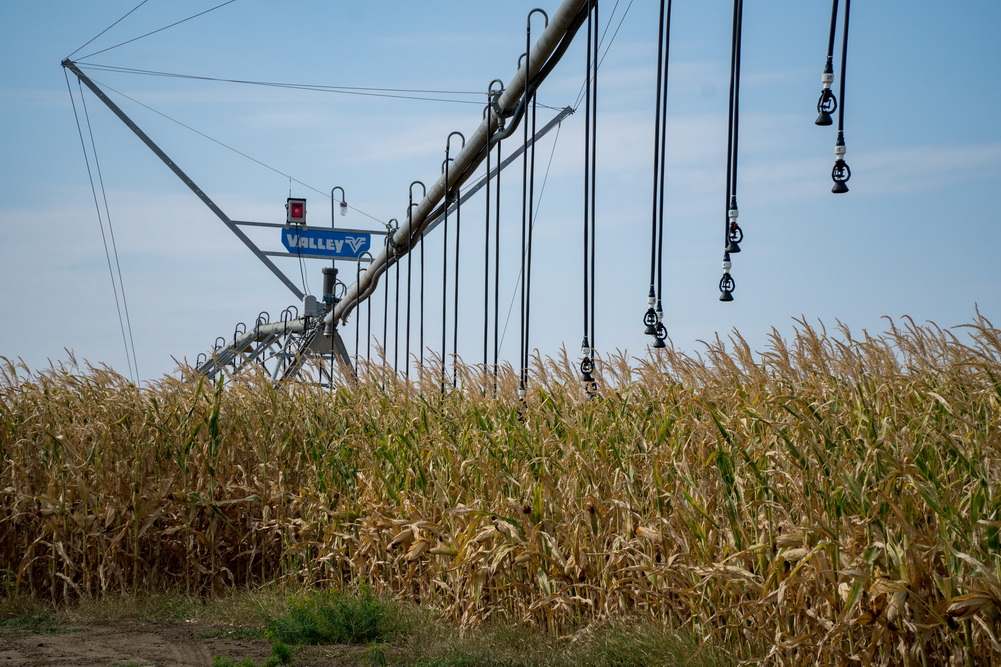
A Valley sprinkler machine
«We carefully studied every option. Quality was the deciding factor. Valley is the flagship among all irrigation machines. Some French suppliers offered us sprinkler machines — and it turned out to be almost a copy of Valley, just an older generation. We chose the new one, so we wouldn’t have to catch up later», — says Serhiy Malovyk.
The farmer says they didn’t expect to launch irrigation in the first year, given the large volume of preparatory work. But, surprisingly, everything got wrapped up fairly quickly. In July of last year the idea caught fire, and a few more months went into studying other enterprises’ experience and negotiating with banks. In the end, they only ordered the Valley equipment closer to winter.

A Valley sprinkler machine
However, before installing them, the underground infrastructure needed to be restored. To make it in time for spring sowing, they started the work that same winter. As a result, they replaced 13 km of pipe. By May 15, when they were sowing corn, it was already under irrigation. Overall, investment in irrigation came to around UAH 45 million, which averages out to $3,000 in costs per hectare.
Valentyn Balytskyi, head of the Valley irrigation-systems division at the “Astra” Agro-Construction Alliance, notes that this is the average cost of an irrigation investment. It’s affected by a number of factors, such as field configuration, distance from the water source and the pump units.
Through thorns…
The enterprise planned to recoup the invested money within 3 years. But due to unforeseen circumstances, that timeframe is shifting to 5 years. Mykola Malovyk says that as soon as “Lan” started with irrigation, the district actively started throwing up obstacles.
«A whole lot of people suddenly wanted to “help”. Imagine a theater of the absurd: the district administration first decides to lease us the ponds, then sues itself in court over making that decision. Another neighbor complained to the prosecutor’s office, again about granting us the right to lease the pond. We haven’t been able to sort this out for a year now. We already got the special water-use permit for the water bodies, made all the paperwork for the ponds, documents for cleaning. Everything we could get —we got, we’re using it, we pay taxes. But at every level they throw up obstacles. In the bureaucrats’ offices they hide all the documents, give us nothing. Before we started irrigation, everyone was fine with everything», —laments the farmer’s son

Mykola Malovyk, farmer, son of the “Lan” agricultural firm’s director
The enterprise’s owner explains the reason for this strange behavior simply. Developing irrigation will automatically raise yields and, accordingly, let them raise the rent paid to people. Local farmers, among whom is the district administration’s own leadership, aren’t inspired by that prospect.
«They’re against irrigation because we’re developing, paying people more for their shares. That’s probably what’s pushing them, to have to pay more. But nobody wants to», — he adds.

Another headache for those wanting to work under irrigation — running a power line to the pump station.
«Running a power line to the pump station — that’s just a fantasy. It’s probably easier to do something on Mars than to break through that wall. There used to be a high-voltage line here, but during the USSR’s collapse it was stripped for parts. Now, to run a line 1.5 km, we’d need to install a 1 MW substation. Under the law, you can’t install less than 2 MW. Getting a permit is impossible — there’s no such norm. We’re already ready to run it at our own expense — but everyone ignores us. This situation hasn’t been resolved for a year now», — the farmer complains.
Because of this, the agricultural enterprise took on additional costs —installing diesel pump stations. And that’s around 40% more expensive than electricity.

A pump station
Water optimists
Despite the difficulties, they have no intention of abandoning what they’ve started at the enterprise, and are even building further plans to “push” the water further. I ask what corn yield they want to reach under “water”, and, getting ahead of the answer, clarify: “Will you hit 12 tonnes?” Serhiy Volodymyrovych smiles: “If we get that, I’ll treat you to a round”.
A more realistic scenario — 8 t/ha — would be akin to a “feat” in this district. Incidentally, at “Lan” they wouldn’t mind returning to “forgotten” crops too, soybean in particular.
«We grew soybean from 2011 to 2015. But it dried up on the stalk for us. Our biggest yield was 1.3 t/ha. Even though its potential is 4.5-5 t/ha. Soybean isn’t as energy- and water-intensive as corn. So we want to come back to this crop», — says the farmer.
17 km from the village runs the Dnipro-Donbas canal. And though the infrastructure is almost entirely stripped, the farmer and his sons are considering “tapping into” this water source too. They’re in talks with officials about that possibility. Though today’s experience suggests you should only count on yourself.

Corn at the “Lan” agricultural firm
Interestingly, the enterprise doesn’t live off crop farming alone, and also has a rich history in hog farming. Just 5 years ago the herd reached 18,000 head. They planned to keep growing volumes, but after pork prices collapsed and African swine fever swept the country, plans changed. Today the herd has shrunk to 3,500 head.
The agricultural company has no cattle, though ambitious plans for this direction existed at one point. Back in 2001, Serhiy Volodymyrovych bought Red Steppe cattle. The herd developed right up until two years in a row of poor silage-corn harvests. The crop dried up on the stalk. Little by little the herd was reduced to zero. But with irrigation now in place, they’re ready to return to raising cattle too.
Irrigated land
Enough talk, let’s head to the fields. We drive out with the farmer’s second son, Serhiy, who picks up the conversation. In the family agribusiness he’s the newest addition. He worked as a surgeon for 10 years at one of Dnipropetrovsk’s hospitals. But in 2013 his agrarian roots pulled him back, and he joined his father’s business.
In March 2014, together with his brother, he visited the John Deere plant in the US. When they got back, the sham referendum in Crimea had just ended and Russia had annexed the peninsula. He was among the first to volunteer for the front. He told his wife he was going for 10 days of medical training, and by March 28 he was already in a “hot spot” — in Amvrosiivka. He served the full term — until the next rotation.
Talking all the way, we reach the field. Here, on 125 ha, corn with an FAO rating of 280 is sown. A Valley circular sprinkler machine is running, with an application rate of 280 m3/h. The unit’s width — 560 m. From sowing to today, the enterprise has poured roughly 1,530 m3 of water per hectare.
Valentyn Balytskyi, head of the Valley irrigation-systems division at the “Astra” Agro-Construction Alliance, says “Lan”‘s irrigation project was interesting, if only from the standpoint that it was built from scratch, starting with the technical documentation, all the way through to technological support.

Valentyn Balytskyi, head of the Valley irrigation-systems division at “Astra” Agro-Construction Alliance (left), and Serhiy Malovyk (right)
«This made it possible to save both water and economic resources, which significantly affects the cost price of the produce, and ultimately — the farm’s profitability and income», — he says.
The expert says investment volumes in irrigation are growing at a colossal pace every year. Just 5-6 years ago, 40 units of imported equipment were coming into Ukraine; today that figure exceeds 250.
In turn, Serhiy Malovyk says they have no intention of stopping at 500 ha and plan to expand the irrigated area. By how much exactly — he’s not ready to say yet, but the plans have already been approved within the enterprise. And not even obstacles from neighbors or officials will get in their way. As his father used to say, “we didn’t choose this path — life forced it on us”.