AGCO/Fendt is developing the next generation of field robots as part of a strategic research project. The new Xaver seeding-robot series differs from its two predecessors in more than just looks. The seeding unit is also entirely new.

If you’re interested in forward-looking, sustainable agricultural technology, you can’t ignore topics like automation and autonomy. Accordingly, since 2017, the advanced engineering department (pre-development) at agricultural machinery manufacturer AGCO/Fendt has been working on strategically oriented topics of the future, such as swarm technologies and robotics. In addition, environmental benefits such as low soil pressure and energy consumption, no noise, leaks or emissions, play an increasingly important role in today’s agricultural economy. Painstaking manual work, which to this day still has to be carried out by many labourers in the field, could be automated in the future. This relieves people from monotonous work and paves a socially justified path toward more environmentally friendly food production.
As part of the Fendt Xaver strategic research project, the entire robotic system was further developed. After thorough field trials, the whole system was revised and reworked, particularly in the area of “smart farming.”

Agronomy down to the details
Technology developed within the AGCO group was integrated into the new generation of Fendt Xaver robots: a seeding unit from Precision Planting. “Thanks to Precision Planting, we were able to use our AGCO group’s agronomic know-how and proven technology for our seeding robots,” says Dr. Benno Pillmayer, Director of Global Technology and Innovation. “We were able to adapt the modules from the first Xaver generations and combine them with the new seeding unit. Proven technology was combined with an innovative robotics concept, resulting in a new, integrated system.”
vSet® technology separates seed quickly and with high precision using negative air pressure (pressure below atmospheric). Using an electrically driven control system, individual seeds are placed in the row with centimetre-level precision at a predetermined spacing. Seed is deposited into the furrow via a flexible closing wheel. In the future, the new Smart Firmer® can also be installed, with Precision Planting sensors to measure soil moisture, temperature, humus content and crop residue. This achieves soil-condition-adapted seeding with variable depth and seeding rate.
Thanks to the three-wheel concept, the last wheel not only drives the robot forward but also functions as a press wheel: moving between the furrows, it gently firms the soil over the seed, improving seed-to-soil contact and thus ensuring a supply of moisture for germination.

Integrating smart technologies
The latest generation of the field robot is also fitted with the VarioGuide tramline-guidance system, which steers the robot with centimetre-level precision. In addition, the Fendt Xaver is integrated into the FendtONE platform, so it can be managed together with the rest of a machine fleet.
This ensures seamless field-data exchange, including guidance tracks, both between the tractor and the robot, and between the robot and the field-map base, making it convenient to create tasks.
“The cornerstones of our swarm system are scalability in terms of investment cost and efficiency, minimizing downtime risk through robot redundancy, and integrating autonomy with precision farming. After the Xaver robot has sown, we have a map of every crop in the field, which forms the basis for all subsequent work, such as chemical crop treatment, mechanical weed control and fertilizer application — regardless of whether it’s carried out by robots or tractors,” says Dr. Benno Pillmayer. “A prerequisite for swarm technology is reliable communication-network coverage. Looking ahead, we’re relying on consistent execution of a digital strategy with 5G network expansion in Germany and worldwide. That means the robots can also represent future Farming 4.0 functions with larger, more dynamic data volumes.”
The seeding robots receive commands via the Fendt Xaver Cloud and send their status reports back through it. The system is a web interface and is managed device-independently through the Xaver app. This way, a farmer or contractor can choose whether to access the entire fleet or individual robots in the field, from a tablet or from the office via a computer. The app itself, in turn, can be opened from the FendtONE portal. The user doesn’t need to enter any additional login data. The Xaver app’s design and user interface match FendtONE standards and are intuitive.

More powerful, yet compact
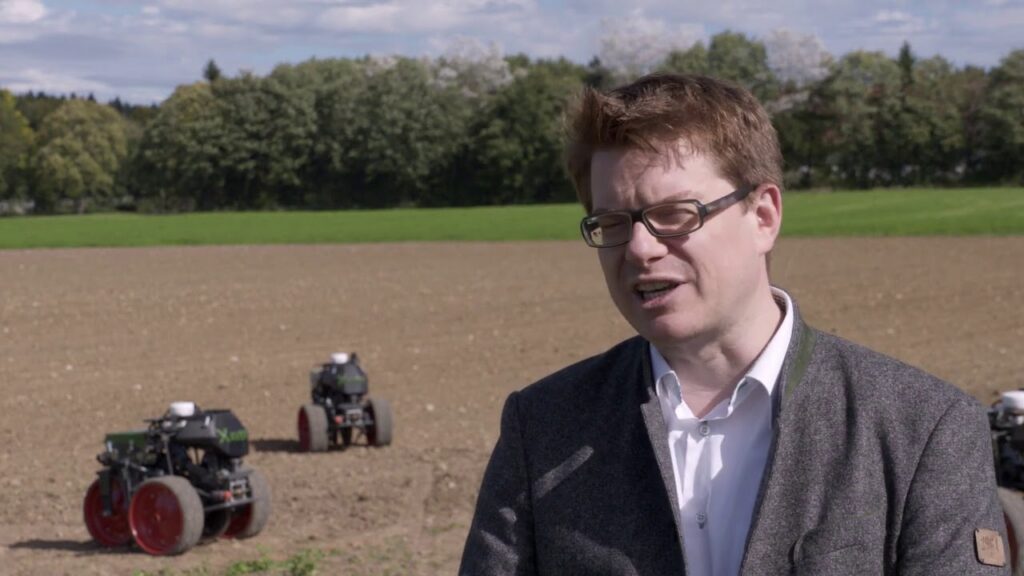
The first thing that catches the eye about the new generation of the Fendt Xaver is the shift in concept from four wheels to three.
Larger wheels provide a wider contact area, greater ground clearance, and more precise depth tracking. The new generation’s strength is especially apparent on the headland: the new Fendt Xaver, just two metres wide, needs practically no space to turn, and thanks to rear-wheel steering and all-wheel drive, does so gently on the soil, even on soft ground.

Additional weights on the front wheels provide not only a smoother ride, but also higher coulter pressure when seeding on loamy soils. In fully ballasted condition, the robot’s maximum total weight is 250 kg, while its own weight is under 150 kg.
The seed hopper has been increased to 20 litres, enough for approximately 0.5 ha at a seeding rate of 90,000 seeds/ha.
The lithium-ion battery’s capacity has been increased to 2.6 kWh. The Fendt Xaver can operate for around an hour and a half before it needs to return to the base station for charging.
A swarm of six robots achieves an output of around 3 ha/h, including loading time of around 2 ha/h. The system supports round-the-clock autonomous use.
The goal of the robotics approach is to offer a smart, resource-efficient and high-output alternative to the persistent trend toward heavier individual large machines. Heavy machines are prone to causing damage, especially on soft or wet soils, leading to yield loss and fewer workable field days.
Society expects sustainable, environmentally friendly food with minimal or no pesticide use. Today, that’s only possible with a large amount of manual labour involved. Robots can ease this monotonous, physically demanding work. Regardless of the specific crop, precision seeding is the foundation for this. Subsequent work, such as cultivation, is significantly simplified, and monitoring and quality support become possible.
Environmental sustainability through smart solutions
“Energy consumption, and thus CO2 emissions, when operating the Xaver compared with traditional technology are significantly lower. The reasons for this are, on one hand, low rolling resistance in the field due to low weight, and on the other, the possible elimination of energy consumers such as air conditioning or steering assistance, since there’s no driver in the machine. Not least, this is helped by an efficient and simple electric direct drive,” explains Dr. Benno Pillmayer.
Besides energy, environmental aspects play a big role too. Seeding robots don’t emit harmful substances into the air, barely make noise, and have no potential oil losses. Soil pressure is up to 80 percent lower than with machines common today.
Significantly lower labour and electricity costs support the Xaver swarm system’s economic sustainability.
Conclusions
The new generation of the Fendt Xaver combines the advantages of small swarm robots with a high-output seeding unit from Precision Planting and the integrated FendtONE digital platform.