Ihor Hubariev, CEO of “Astra” Agro-Building Alliance
The first days of the war: the team, the company, the market
On February 24, 2022, Ukraine woke up to terrifying, thunderous explosions. It was a bad morning — the war had begun. By 7 a.m., the entire leadership of ABA “Astra” was already discussing a plan of action for the coming hours. The plan was simple — save the employees and their families. Those who worked remotely got the chance to collect their families and take them somewhere safe. Those who needed help or advice wrote in a shared Telegram chat. Everyone helped everyone. It was a moment of unity, but also of great despair.
Many employees’ families urgently left for Hungary, where staff of the company’s Budapest office met and housed them. Our Hungarian founders took care of this, and we are sincerely grateful to them. The corporate Telegram chat was overflowing with messages: which route to take and where, where to refuel, what to do about expired documents, what to do with pets. And all of this to the sound of air-raid sirens, explosions, and terrifying reports of the enemy’s advance. There was almost no time to think.

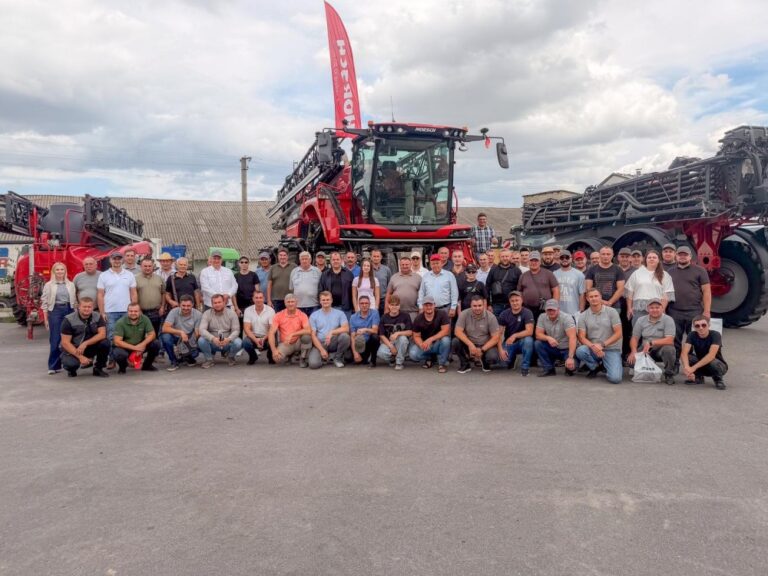
The ABA “Astra” team, 2023
Once everyone was finally safe, it was time to save the business. It was Monday, the fourth day of the war. We evacuated machinery from showgrounds and farms; we split up and moved a large spare-parts warehouse worth 7 million euros to cities further from the front; we cleared out all the warehouses at our branches in Kharkiv, Sumy, and Mykolaiv. We won’t go into detail about how we managed all this — in truth, most businesses in Ukraine faced something similar from the very first days of the invasion.
The market, businesses, and ultimately the whole country turned out to be unprepared for this new reality, for the chaos and panic that reigned in the first days and weeks of the war. This led to painful losses.
A separate headache came with a shipment of irrigation systems at the port of Odesa. 16 containers had arrived there just days before the war and, naturally, got stuck from the moment of the invasion. Russian ships blockaded the port, and then the Russians began shelling it. We were lucky — the cargo wasn’t damaged, and at the first “window” we moved it to Vinnytsia. We’ll come back to the blockade of ports as one of Russia’s strategies of aggression.
Part of our business is selling machinery on credit. So as soon as the war began, many of our clients ran into a shortage of funds to pay — we had to start accepting payment in harvest. But we’re not traders! To find some way to sell the grain, we had to make countless calculations and negotiations, export the harvest, and ultimately reach a financial result.
Could we have prepared in advance and acted more effectively? Probably, yes. But we didn’t believe a large-scale war was even possible in the 21st century, in the heart of Europe. As we now see, our enemy didn’t believe it either, and was only prepared for a blitzkrieg — but the blitzkrieg didn’t happen; what happened was a war of attrition. The market, businesses, and ultimately the whole country turned out to be unprepared for this new reality, for the chaos and panic that reigned in the first days and weeks of the war. This led to painful losses.
19 months of war: losses, changes, plans
Our most painful loss is the lives of many Ukrainians, and that can no longer be undone. We may be able to bring back most of those who went abroad. Perhaps in the future we’ll be able to rebuild businesses and infrastructure. We’re holding on, but the market is shrinking.
ABA “Astra” sells and services imported agricultural machinery. We see a clear trend — the market has been shrinking by 25% every year since the war began. According to KSE data, agricultural machinery worth almost $4.7 billion has been stolen, destroyed, or damaged. Recovering from such losses is extremely difficult, because they are colossal.
The “grain deal” has ceased to exist, some countries are blocking Ukrainian exports, Russia is shelling and terrorizing Danube ports, and domestic grain prices keep falling. Agricultural exports from Ukraine are falling short of the 4 million tonnes per month threshold, and that means only one thing — farmers have stopped selling their harvest and are waiting to see how things develop; they are no longer investing. We don’t know what the situation will look like in the future, but what’s happening right now is a severe crisis.
Russia is using food as a tool to blackmail the global community. To stop the enemy from carrying out its plans, our state needs to find alternative export routes for agricultural produce — cheaper ones, with greater throughput.
Russia opened an agricultural front when it blocked the route for our exports, stole part of our harvest, and is trying to seize our place in the world’s food market. On top of that, Russia is using food as a tool to blackmail the global community. To stop the enemy from carrying out its plans, our state needs to find alternative export routes for agricultural produce — cheaper ones, with greater throughput. US General John Pershing, of First World War fame, once said: “Infantry wins battles, logistics wins wars.” That applies not only to classic military conflict, but to the competitive battle for the global food market too.
We plan for the future very cautiously, but with optimism. The war will end in our Victory — there’s no doubt about that. Ukrainian producers who hold on and stand firm now will gain a unique kind of “immunity” and will raise their own competitiveness and profitability. The end of the war will mean the restoration of safe cargo-ship traffic in the Black Sea, and so our agricultural sector has a promising future and rapid growth ahead of it. Perhaps we’re idealizing things, but today’s experience shows that Ukrainian grain is capable of influencing world politics, becomes a topic of heated debate among the world’s power brokers, and forces a rethink of the established political habits of influential (and less influential) international organizations.
Grain is Ukraine’s oil. But this grain is grown by sincere, hardworking Ukrainian people, so we must take care of people, we must support the Ukrainian nation.
The birth of the Support Ukrainian People project
The war began in winter. In the first days, products started disappearing from store shelves, and it became almost impossible to withdraw cash from ATMs. It was clear things would only get worse. The ABA “Astra” team decided to organize humanitarian aid. We arranged delivery of 7 large trucks from Germany. Medicine, clothing, food, hygiene products, and much more were handed over to staff of the Vinnytsia Regional State Administration, who then distributed the cargo where it was needed.
Living through war is psychologically hard, but think about how it feels for those confined to beds in cold hospital wards, with no heating, no loved ones nearby, and no hope that there will ever again be happy moments in their lives. Our doctors fight for their patients’ health, and we help them do it in warmth and comfort. Powerful generators were delivered and installed at the Orativ Hospital for Scheduled Treatment (Vinnytsia region), the Third City Emergency Hospital (Cherkasy), and the Pryluky Central District Hospital (Chernihiv region). Our partners at AGCO Ukraine and the “MHP — to the Community” charitable foundation helped make this possible.

Pupils of the Denyshiv Special School under the Zhytomyr Regional Council
War is a terrifying trial for everyone, especially for children. We looked into their eyes, held their hands, and thought with dread: “What would we have grown up to be, if there had been a war in our childhood?” — that’s a terrifying question. So we started helping children from the Denyshiv Special School under the Zhytomyr Regional Council. This school teaches children with special needs — I think you understand what that means. We brought them warm clothes, blankets, toys, food, and various treats. But the most important thing we could give was conversation and emotional support for the children.
War is a terrifying trial for everyone, especially for children. We looked into their eyes, held their hands, and thought with dread: “What would we have grown up to be, if there had been a war in our childhood?” — that’s a terrifying question.
Compassion and care can’t be reduced to a job, but turning that care into action for those who need it is daily work. Perhaps that’s the duty of any decent person, but it’s certainly the duty of a responsible business. This year, ABA “Astra” turned 25. It’s a landmark anniversary, one that in peacetime we would have celebrated loudly somewhere scenic, but instead we created a project to help people cope with the hardships of war. We named the project that brings together all our past and future charitable initiatives — 1. It brings together ABA “Astra” leaders and employees, our partners and clients, foundations, organizations, companies, and caring citizens.
There’s no way to stay on the sidelines of this war — not just because it’s happening across the whole country, but because there’s no longer anywhere left to go back to and say: “Everything here is just like it used to be.” Change has already happened, and we too need to change to match the new reality. It’s hard, but it has to be done. Surviving the Russian onslaught, rebuilding, becoming even better and even stronger — that’s our shared goal. And the common good is everyone’s job!
Charity is a new way of life, work, and communication
Foundations collect donations — that’s their job. Donations are collected inside Ukraine and beyond its borders. Donations are collected by big, national-scale businesses. Donations are collected by small local companies. Donations are collected by ordinary citizens on personal cards. Donations are collected by children. The whole country is collecting donations.
The unity of people in their desire to help the Defense Forces and their country is striking. Many people, on their birthday, ask for donations to some fundraiser instead of gifts, so charity is becoming part of our everyday life.
Charity is also becoming a necessity for business. How can we plan the future of our companies if we don’t join in helping those who are winning that future at the cost of their own lives? Beyond ethical and patriotic considerations, executives and marketers need to recognize that their companies’ marketing budgets can become part of the Victory Budget. It sounds grand and unusual, but branded merchandise or annual corporate parties can easily turn into drones, vehicles, or tactical medicine for an entire battalion. And then that battalion will operate far more successfully and with fewer losses.
Beyond ethical and patriotic considerations, executives and marketers need to recognize that their companies’ marketing budgets can become part of the Victory Budget.
It’s important not just to donate, but also to clearly and openly state your position — that we support Ukraine and its Defense Forces. That position matters for Victory just as much as donations do, because it shows the whole world that business stands on the side of good and peace, on the side of Ukraine. In this war there are no shades of gray or compromises — we are opposites of the Russians in everything. Russian forces are stealing Ukrainian grain because their own farmers can’t bring in a decent harvest at home, while Ukrainian farmers, in spite of everything, are bringing in an outstanding harvest and supporting the Armed Forces of Ukraine.
An agricultural company runs a fundraiser for the Armed Forces’ Territorial Defense
At the start of the war, we had to try on the role of a trader; now we’re trying our hand as volunteers, raising funds to help the Armed Forces’ Territorial Defense. Before the war, many people in peaceful professions could never have imagined they’d end up in trenches with weapons in their hands, but life had other plans. That is, in effect, what the Territorial Defense units are. At the time, many of our employees volunteered for the front, and some were mobilized into the Armed Forces later. As a company, we support our colleagues who serve with everything they need, but we came to understand that more support was needed.

Handing over supplies to soldiers of a separate Territorial Defense battalion of the Armed Forces of Ukraine
Supporting military unit A7329 of the Armed Forces’ Territorial Defense became the most complex task and challenge for ABA “Astra” and the Support Ukrainian People project. I personally visited the soldiers, got to know them, and discussed their urgent needs — buying and repairing vehicles, various equipment, drones, communications gear. As it turned out, keeping the unit properly equipped requires a great deal of varied support. The amount needed is UAH 2,500,000. ABA “Astra”‘s contribution — UAH 1,000,000. But that’s not enough, so we decided to bring in our partners, our clients, and caring citizens to help raise the rest. Our partner, the “Kyivan Rus” Charitable Support Fund, is helping us organize the fundraiser. To encourage donors we launched a promotional campaign to spread the word, created a donation page (opens in a new tab), and produced video content. We also have an official appeal from the unit’s command, and we will hand over everything needed openly and transparently. We hope everything works out.
Before the war, many people in peaceful professions could never have imagined they’d end up in trenches with weapons in their hands, but life had other plans. That is, in effect, what the Territorial Defense units are.
We see the statistics on the biggest fundraisers across Ukraine, and it’s striking. Some volunteers never reached their announced target, and there are plenty of those too. Raising donations has become an industry with fierce competition, its own leaders, and a substantial market size in monetary terms. Anyone who decides to raise funds and help the Defense Forces needs a real strategy and active marketing to be heard and to get people involved. For us, as an agricultural company, this has effectively become our marketing strategy for the years ahead.
A long war impoverishes a nation, tests its spirit, and drains its strength. We need to find our “second wind,” to make the fight part of life. Then every new trial will be just a step forward, not a verdict. As Winston Churchill said: “Success is the ability to go from one failure to another with no loss of enthusiasm.”
The world has changed, but we remain Ukrainians
Some say the UN needs to be reorganized, because it failed at its main task — preventing a large-scale war in Europe and the world. They say the world’s security architecture is broken and needs rethinking. Some even believe modern civilization itself has entered an era of global change, and no one knows where these changes will lead us. Maybe that’s true. What matters is that it is precisely Ukrainians who found themselves at the very center of historic and tragic events. Making history is a task for courageous, brave people, driven by a thirst for freedom and self-expression.
We face serious challenges ahead: victory in the war, rebuilding the country, carrying out important and painful reforms, reviving the economy, and, most importantly, bringing our people back home. We will manage all of this, however hard it is. To be Ukrainian is to be free, and only free people change the world!
Ihor Hubariev, CEO of “Astra” Agro-Building Alliance
Fundraising details:
Donation page (opens in a new tab)
“Kyivan Rus” Charitable Support Fund, for the needs of Territorial Defense unit A7329 of the Armed Forces of Ukraine
JSC CB “PRIVATBANK”, Kyiv City Settlement Center
EDRPOU 39427776, MFO 320649
IBAN UA713052990000026007045000577
Card number for transfers in national currency (Privatbank, UAH)
5169 3305 3053 2487